Intro to Western Music Theory
Introduction
- We’ve already investigated some of the foundational principles of our perception of sound and the Pythagorean approach to finding combinations of frequencies that sound good together.
- There are a couple issues with the Pythagorean approach that didn’t get resolved for almost two millennia!
- In this session,
- we’ll talk about the pros and cons of different tuning systems,
- why there’s no perfect solution to some of the problems that arise,
- and introduce some of the basic principles of western music theory
Problem with Pythagorean Tuning
- Using the system we discussed in the last section, Pythagorus landed on a twelve-tone system
| Root | 2 | 3 | 4 | 5 | 6 | 7 | 8 | 9 | 10 | 11 | 12 | Root |
|---|---|---|---|---|---|---|---|---|---|---|---|---|
| $1$ | $\frac{256}{243}$ | $\frac{9}{8}$ | $\frac{32}{27}$ | $\frac{81}{64}$ | $\frac{4}{3}$ | $\frac{729}{512}$ | $\frac32$ | $\frac{128}{81}$ | $\frac{27}{16}$ | $\frac{16}{9}$ | $\frac{243}{128}$ | $2$ |
- The problem with this system is that the distances between successive notes are not all the same.
Overtones
- The Pythagorean approach of using only the very pleasing ratios of $2:1$ and $3:2$ to construct a scale seems sensible.
- But, we might notice that some of the ratios we end up with in this $12$-note system have fairly large numerators and denominators: look at the second, fifth, seventh, and twelfth notes, for example.
- Pythagorus was right that small ratios produce pleasing sounds. The reason has to do with the overtone series we discussed in the previous chapter.
- Remember, if you sing a pitch of 100 Hz, you’re creating overtones of 200, 300, 400, 500, 600, …
- So there’s a perfect fifth ($3:2$ ratio) in that one note you’re singing
- Other tuning systems have tried to replace some of the Pythagorean ratios with smaller ones.
- For example, instead of $81/64$, we could use $5/4$
Comparing
| Note: | Root | 2 | 3 | 4 | 5 | 6 | 7 | 8 | 9 | 10 | 11 | 12 | Root |
|---|---|---|---|---|---|---|---|---|---|---|---|---|---|
| Pyth. | $1$ | $\frac{256}{243}$ | $\frac{9}{8}$ | $\frac{32}{27}$ | $\frac{81}{64}$ | $\frac{4}{3}$ | $\frac{729}{512}$ | $\frac32$ | $\frac{128}{81}$ | $\frac{27}{16}$ | $\frac{16}{9}$ | $\frac{243}{128}$ | $2$ |
| Just | $1$ | $\frac{16}{15}$ | $\frac{9}{8}$ | $\frac{6}{5}$ | $\frac{5}{4}$ | $\frac{4}{3}$ | $\frac{45}{32}$ | $\frac32$ | $\frac{8}{5}$ | $\frac{5}{3}$ | $\frac{9}{5}$ | $\frac{15}{8}$ | $2$ |
Equal Temperament
- Most modern music uses equal temperament, where the distances between all the notes are equal.
- How do we do this?
- We want twelve notes in total within one octave.
- An octave is a $2:1$ ratio.
- So, we need a multiplier, $r$, such that $r \cdot r \cdot r \cdots r = r^{12} = 2$
- $\boxed{r = \sqrt[12]{2}}$
- What are the cons here?
- If small integer ratios sound best and are embedded in the overtones of all pitched sounds, then it’s like everything in equal temperament is slightly out of tune.
Notes
| 1 | 2 | 3 | 4 | 5 | 6 | 7 | 8 | 9 | 10 | 11 | 12 | 1 |
|---|---|---|---|---|---|---|---|---|---|---|---|---|
| C | C$\sharp$ | D | D$\sharp$ | E | F | F$\sharp$ | G | G$\sharp$ | A | A$\sharp$ | B | C |
| D$\flat$ | E$\flat$ | G$\flat$ | A$\flat$ | B$\flat$ |
- Okay, so why different ways of naming the same note (called enharmonic)?
- The major scale, which we’ll define next, has seven notes.
- With sharps and flats, we can write out the notes of any scale without reusing letters.
- So, if a scale has an F in it, we would prefer to use G$\flat$ rather than F$\sharp$
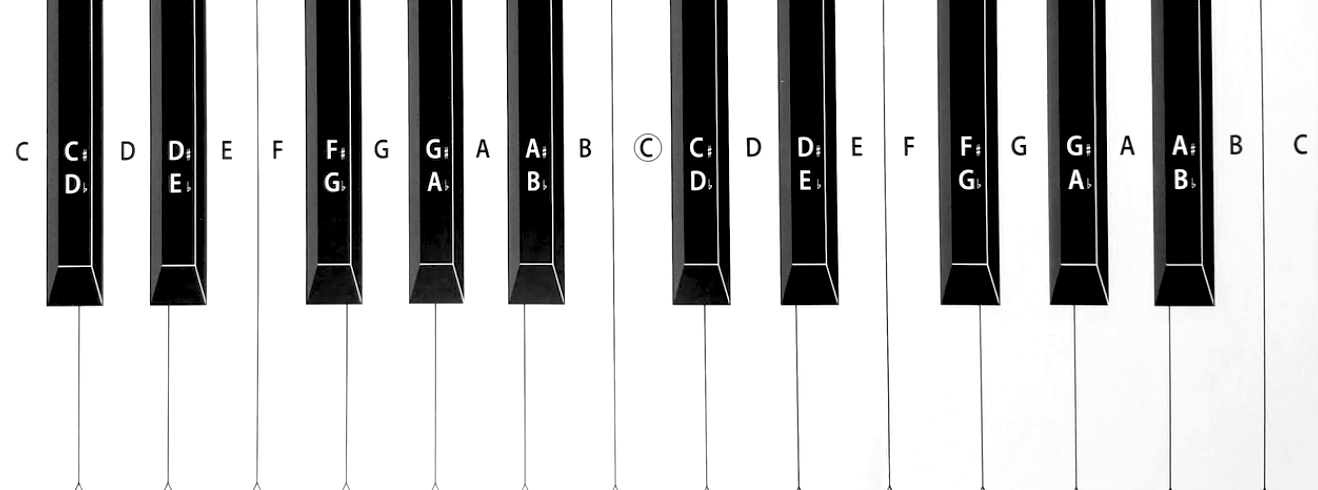
- MIDI notes got from 0 - 127
- 0 is a C
- 60 is middle C or C4
Whole Tones and Semitones
- One octave is split into twelve semitones or half-steps: this is the distance between two adjacent notes.
- E.g., B and C are a semitone apart. Same with G and A♭. Same with D♯ and E
- The theme song to Jaws is just two notes a semitone apart!
- A whole tone or whole step is two semitones.
- E.g., C and D are a whole tone apart. Same with G and A. Same with E and F♯
- Scales and chords can be defined in terms of whole steps and half steps
Major Scale
- Scales are just subsets of our twelve notes
- If we take all twelve, we call this the chromatic scale
- We can define our scales according to half steps and whole steps
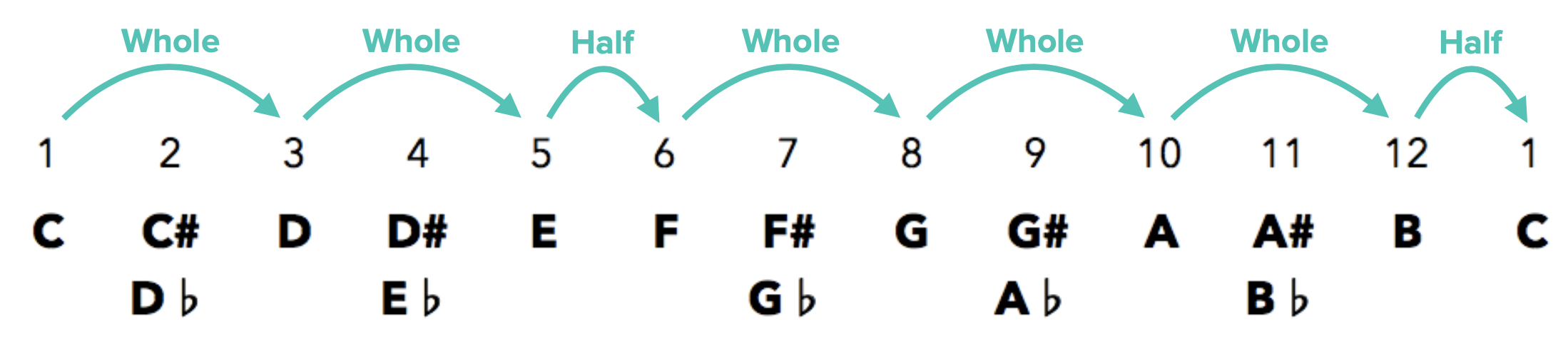
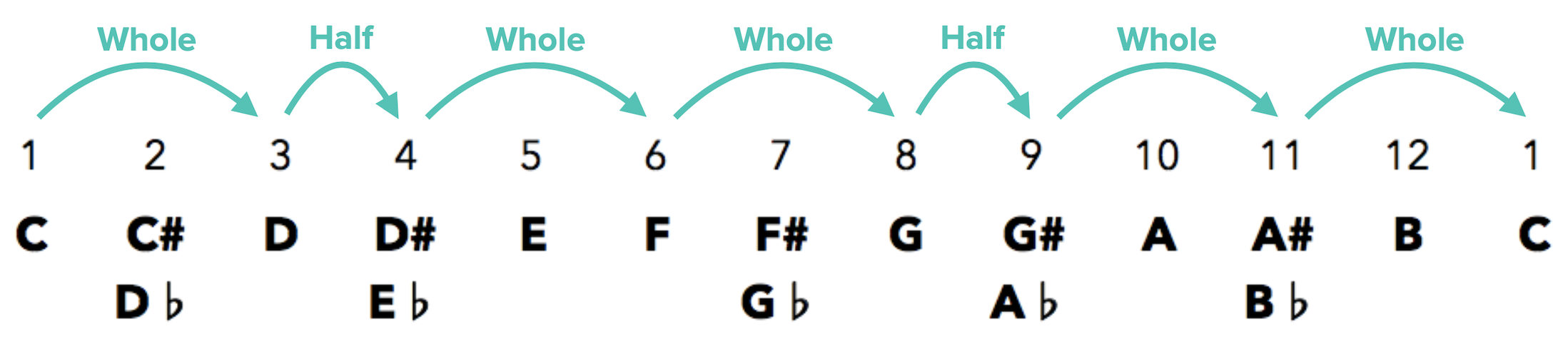
- E.g., the major scale has the following pattern: W W H W W W H
- Or if counting makes it easier: 2, 2, 1, 2, 2, 2, 1
- Starting on C, we get C D E F G A B C
Practice
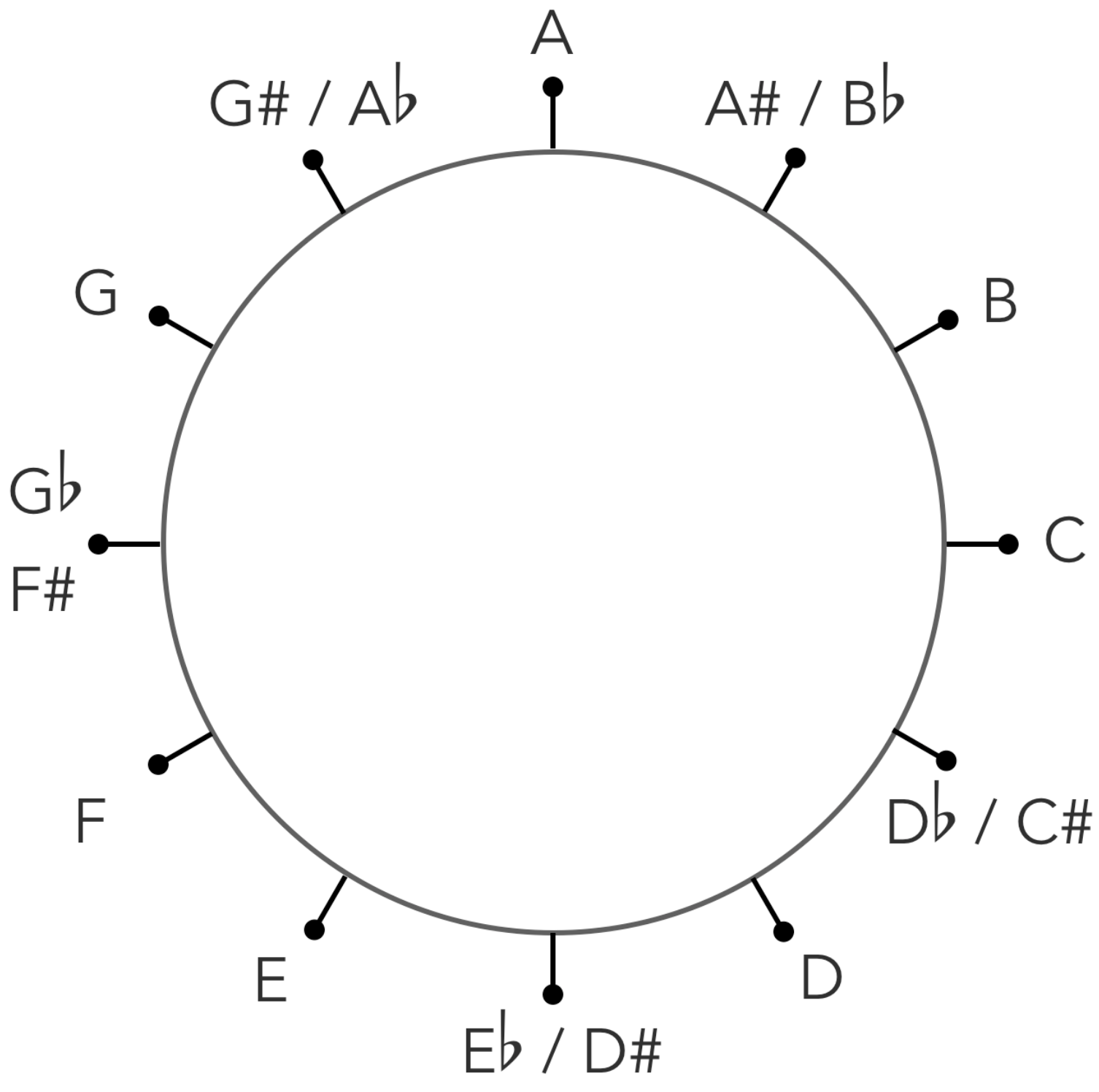
- Write out the notes for each of the following scales
- Where possible, try not to repeat letters.
- D-major
- A-major
- F-major
Minor Scale
- The minor scale has the following pattern: W H W W H W W
- Or if counting makes it easier: 2, 1, 2, 2, 1, 2, 2
- Starting on C, we get C D E$\flat$ F G A$\flat$ B$\flat$ C
Practice
- Write out the notes for each of the following scales
- Where possible, try not to repeat letters.
- B-minor
- A-minor
- E-minor
Quick way to play scales in Sonic Pi
We can listen to scales easily in Sonic Pi using the following line of code
play_pattern_timed scale(:c4, :minor), 0.25, release: 0.25
- For the choice of starting note, you can use
sfor sharp andbfor flat and change the number 4 to a different octave- So,
eb4would give us the E$\flat$ after middle C - Likewise,
fs3would give us the F$\sharp$ below middle C
- So,
Chords
- A chord is two or more (usually three or more) different notes played simultaneously
- Four primary types - made up of three notes
- Major
- Minor
- Diminished
- Augmented
- Four primary types - made up of three notes
- Adding notes to these basic types builds “color,” but the types stay the same
- The order in which the notes of a chord are played doesn’t change the kind either, but people will usually specify
- For the four basic chord types, we try to use every other letter as often as possible
Major Chords
- Typically written with root note name - e.g., C major: C
- Three notes
- (1) Root (2) W + W (3) W + H
- (1) Root (2) + 4 (3) + 3
- C major chord
- C-E-G
Minor Chords
- Typically written with root note name followed by a lower case m - e.g., C minor: Cm
- Three notes
- (1) Root (2) W + H (3) W + W
- (1) Root (2) + 3 (3) + 4
- C minor chord
- C-E♭-G
Diminished and Augmented Chords
- Diminished
- (1) Root (2) W + H (3) W + H
- (1) Root (2) + 3 (3) + 3
- C diminished chord (C°)
- C-E♭-G♭
- Augmented
- (1) Root (2) W + W (3) W + W
- (1) Root (2) + 4 (3) + 4
- C augmented chord (C+)
- C-E-G♯
Practice
Find the notes in each of the following chords. Try to name the notes with every other letter by using sharps and flats appropriately.
- B major
- G minor
- E diminished
- B♭ major
- D♯ augmented
- A minor
- F♯ minor
- D diminished
- E major
Solutions
- B major: B - D♯- F♯
- G minor: G - B♭- D
- E diminished: E - G - B♭
- B♭ major: B♭- D - F
- E♭augmented: E♭- G - B
- A minor: A - C - E
- F♯ minor: F♯ - A- C ♯
- D diminished: D - F - A♭
- E major: E - G♯- B
Playing Chords in Sonic Pi
We can just specify the notes by name, as we did before.
play [:c4, :e4, :g4]
By MIDI number
play [60, 64, 63]
Or using the built-in chord functions
play_chord chord(:c4, :major)
Chords in a Major Scale
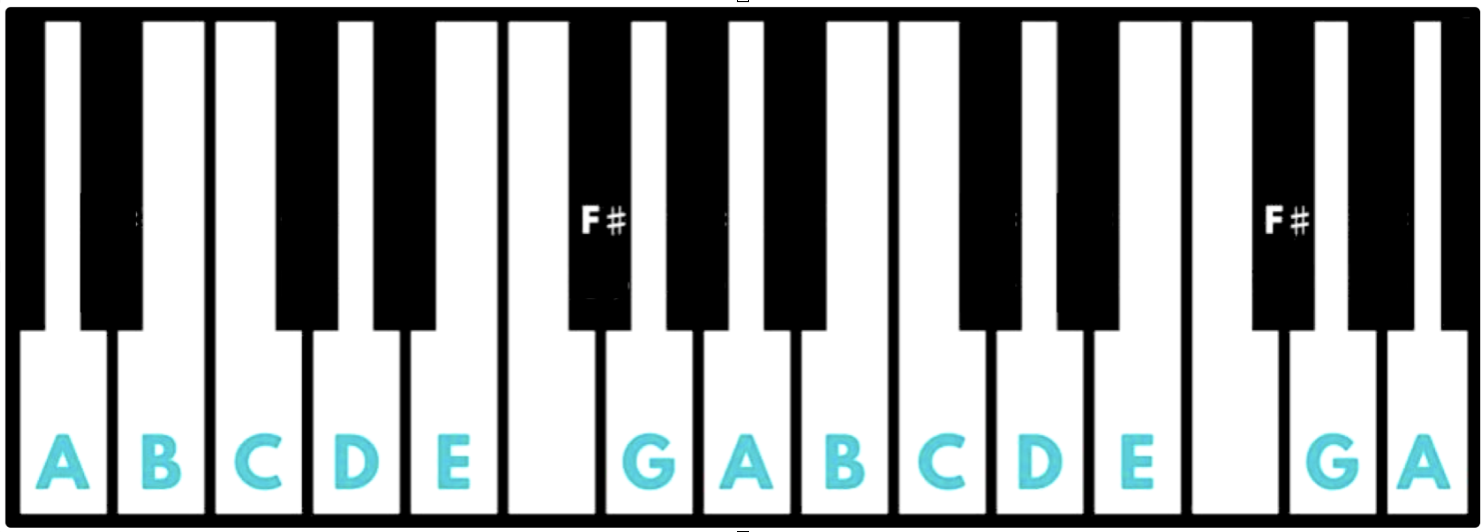
- Let’s take the notes in a G-major scale
- G A B C D E F# (G)
- There are seven basic chords embedded in this scale. Can you find them?
Pattern of Major, Minor, and Diminished Chords
- G major: G - B - D
- A minor: A - C - E
- B minor: B - D - F♯
- C major: C - E - G
- D major: D - F♯ - A
- E minor: E - G - B
- F♯diminished: F♯- A - C
One more example
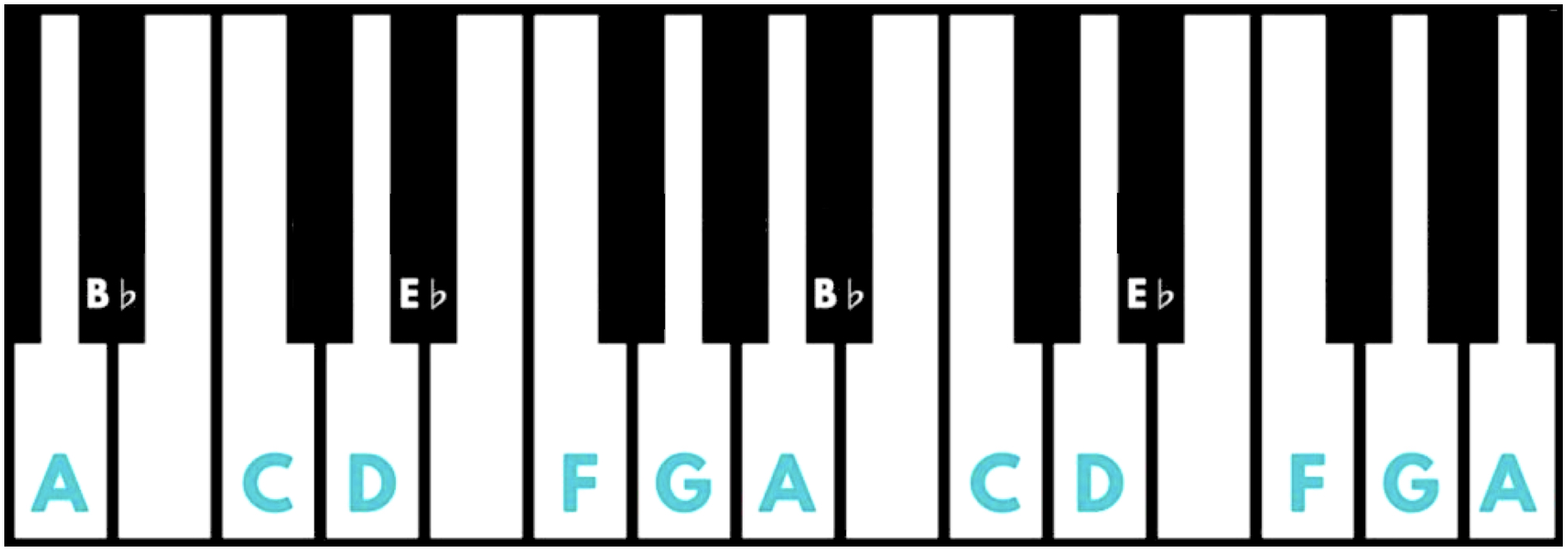
Repeat the same exercise for the Bb major scale.
What do we notice?
- Three Major Chords: Built from the first, fourth, and fifth notes of the major scale
- Three Minor Chords: Built from the second, third, and sixth notes of the major scale
- One Diminished Chord: Built from the seventh note in the scale
Chords in a Major Scale with Notation
| Degree of Scale | Chord Type | Symbol | | | - | - | | 1 | Major | $I$ | | 2 | Minor | $ii$ | | 3 | Minor | $iii$ | | 4 | Major | $IV$ | | 5 | Major | $V$ | | 6 | Minor | $vi$ | | 7 | Diminished | $vii\circ$ |
Activity
Let’s find the major scale that best fits some songs we like.
Digging Deeper
Rather than describing the relationships between notes, or intervals, in numerical terms, it can be really helpful to assign names to the intervals.
| Interval | Name | Short | Interval | Name | Short |
|---|---|---|---|---|---|
| +0 | Unison | P1/Root | +7 | Perfect Fifth | P5 |
| +1 | Minor Second | m2 | +8 | Minor Sixth | m6 |
| +2 | Major Second | M2 | +9 | Major Sixth | M6 |
| +3 | Minor Third | m3 | +10 | Minor Seventh | m7 |
| +4 | Major Third | M3 | +11 | Major Seventh | M7 |
| +5 | Perfect Fourth | P4 | +12 | Octave | P8 |
| +6 | Tritone | d5 or A4 |
Building Chords and Scales with Intervals
- Major chord: Root + Major Third + Fifth (P1 + M3 + P5)
- Minor chord: Root + Minor Third + Fifth (P1 + m3 + P5)
- Diminished: Root + Minor Third + Tritone (sometimes called flatted fifth) (P1 + m3 + b5)
- Augmented: Root + Major Third + Fifth (P1 + M3 + #5 (m6))
- Major Scale: Root, M2, M3, P4, P5, M6. M7, P8
- Minor Scale: Root, M2, m3, P4, P5, m6, m7, P8
Building More Interesting Chords
- Seventh Chords add either the major or minor seventh for more color and character
- Major Seventh Chord: Root + M3 + P5 + M7
- Minor Seventh Chord: Root + m3 + P5 + m7
- Dominant Seventh Chord: Root + M3 + P5 + m7
- Minor-major Seventh Chord: Root + m3 + P5 + M7
- Diminished Seventh Chord: Root + m3 + d5 + M6
Activity
- Write a chord progression with at least three chords in a particular key (you can repeat chords, of course). Label them with the appropriate chord notation.
- Add a randomly generated melody
- Add drums or percussion
I = [48, 55, 60, 64, 71]
ii = [50, 57, 60, 65, 69]
V = [50, 55, 62, 65, 71]
vi = [52, 57, 60, 67, 69]

with_fx :reverb do
  live_loop :chords do
    play [I, vi, ii, V].tick, sustain: 1
    sleep 2
  end
end
Outside the Western Box
Hindustani Classical Music
- Hindustani classical music is a great example of a justly-tuned system.
- Unlike western music, where each note refers to a specific frequency, this is a tradition in which there are ranges of acceptable frequencies.
- Might sound “out of tune” to western ears at first, but it’s actually incredibly precise.
| Note | C | D♭ | D♭ | D | D | E♭ | E♭ |
|---|---|---|---|---|---|---|---|
| Ratio | 1:1 | 256:243 | 16:15 | 10:9 | 9:8 | 32:27 | 6:5 |
| Cents | 0 | 90 | 112 | 182 | 204 | 294 | 316 |
| Note | E | E | F | F | F♯ | F♯ | G |
|---|---|---|---|---|---|---|---|
| Ratio | 5:4 | 81:64 | 4:3 | 27:20 | 45:32 | 729:512 | 3:2 |
| Cents | 386 | 408 | 498 | 520 | 590 | 612 | 702 |
| Note | A♭ | A♭ | A | A | B♭ | B♭ | B | B | C |
|---|---|---|---|---|---|---|---|---|---|
| Ratio | 128:81 | 8:5 | 5:3 | 27:16 | 16:9 | 9:5 | 15:8 | 243:128 | 2:1 |
| Cents | 792 | 814 | 884 | 906 | 996 | 1018 | 1088 | 1110 | 1200 |
Genesis of a Music
Activity: Build the 7-limit tonality diamond
- Build the 7-limit tonality diamond
- Put the fractions in order and play them in sonic pi
| 1/1 | ||||||
|---|---|---|---|---|---|---|
| 12/7 | 7/6 | |||||
| 10/7 | 1/1 | 7/5 | ||||
| 8/7 | 5/3 | 6/5 | 7/4 | |||
| 4/3 | 1/1 | 3/2 | ||||
| 8/5 | 5/4 | |||||
| 1/1 |
Consonance and Dissonance
- Consonance and dissonance are terms used to categorize combinations of notes (intervals).
- Consonance (from latin con sonare) refers to notes that “go together” or sound pleasing to the ear
- Dissonance refers to notes that “clash” or sound less pleasant together
- It’s not necessarily a matter of “good” and “bad” though as dissonance can create useful tension.
- Also, the context of a dissonant interval can change how we perceive it.
- For example, B and C might sound dissonant together, but in the context of a Cmaj7 chord (C E G B), that interval sounds much less dissonant.
Classifying Intervals
How might we classify the twelve intervals in our twelve-note system? Let’s rank them from consonant (1) - dissonant (12).
| Interval | Name | Ranking | Interval | Name | Ranking |
|---|---|---|---|---|---|
| +0 | Unison | +7 | Perfect Fifth | ||
| +1 | Minor Second | +8 | Minor Sixth | ||
| +2 | Major Second | +9 | Major Sixth | ||
| +3 | Minor Third | +10 | Minor Seventh | ||
| +4 | Major Third | +11 | Major Seventh | ||
| +5 | Perfect Fourth | +12 | Octave | ||
| +6 | Tritone |
Species Counterpoint
-
Species counterpoint is a step-by-step method for learning to write melodies and to combine them.
-
Consonance and dissonance:
- Perfect consonances: perfect unisons, fifths, and octaves
- Imperfect consonances: major and minor thirds and sixths
- Dissonances: all seconds, sevenths, and diminished and augmented intervals
-
Types of two-part motion:
- Contrary: the two parts move in opposite directions (one up, the other down
- Similar: the two parts move in the same direction (both up or both down)
- Parallel: the two parts move in the same direction (both up or both down) by the same distance, such that the starting and ending intervals are of the same type (e.g., parallel thirds)
- Oblique: one part moves, the other stays on the same pitch
First Species Counterpoint
The Rules
- Begin on a perfect unison, fifth, or octave.
- Both voices move at exactly the same rate and have no rhythmic variety (for example, all notes are whole notes).
- Harmonically, the intervals between the two voices are all consonances.
- Melodically, prefer stepwise motion and leap only occasionally. Melodic leaps of a tritone or seventh are forbidden.
- Parallel perfect consonances are forbidden.
- End with a perfect unison or octave.
Activity: Compose a simple melody with counterpoint
- Compose a very simple melody of at least 7 notes in a key of your choosing
- Follow the rules of first species counterpoint to create a harmony line
- Implement in Sonic Pi
melody       = [60, 62, 65, 64, 69, 71, 72]
counterpoint = [67, 65, 69, 67, 72, 74, 72]

melody.length.times do |i|
	play [melody[i], counterpoint[i]]
	sleep 1
end