Computing Limits
In this section, we’ll focus on computing limits algebraically, without relying on graphs/tables. To do so, we’ll consider several cases.
Three Cases
If $x$ is approaching a finite value in a non-piecewise function, there are three cases we need to consider.
-
We plug $a$ into $f$ and get a real value.
-
We plug $a$ into $f$ and get $\frac00$.
-
We plug $a$ into $f$ and get $\frac{k}{0}$, where $k \neq 0$.
Case 1: Plug in and get a real value
If $f(a)$ is a real number, then $$\lim_{x \to a} f(x) = f(a)$$ In other words, if we can plug $x = a$ into the function and get an answer, we’re done!
Here’s an example:
Example
$$\lim_{x\to3}\frac{2}{x^2 - 1} = \frac{2}{3^2 - 1} = \frac28 = \boxed{\frac14}$$
We plugged $x = 3$ directly into the function $\frac{2}{x^2 - 1}$ and got $\frac14$. That’s it. We’re done!
There’s not too much more to say about this first case. But here are a few more quick examples:
- $\lim_{x\to0} \frac{x - 1}{x + 5} = \frac{(0) - 1}{(0) + 5} = -\frac15$
- $\lim_{x\to-3} e^x = e^{-3}$
- $\lim_{x\to1} \cos(\pi x) = \cos((1)\pi) = -1$
We should always start by trying to plug in $x = a$.
Exercise
Compute each of the following
- $\lim_{x \to 5} \tan(\pi x)$
- $\lim_{x \to 0} \ln (x + 1)$
- $\lim_{x \to 1} e^{\cos(\pi x)}$
Solution
- $\lim_{x \to 5} \tan(\pi x) = \tan 5\pi = 0$
- $\lim_{x \to 0} \ln (x + 1) = \ln (0 + 1) = 0$
- $\lim_{x \to 1} e^{\cos(\pi x)} = e^{\cos(\pi)} = e^{-1}$
Properties of Case 1 Limits
Suppose we have two functions that have Case 1 limits at $x = a$. $$\lim_{x \to a} f(x) = M$$ $$\lim_{x \to a} g(x) = N$$ Then the following properties hold
- $\lim_{x \to a} \left(f(x) + g(x)\right) = M + N$
- $\lim_{x \to a} f(x)\cdot g(x) = M \cdot N$
- $\lim_{x \to a} f(x)/g(x) = M/N$ so long as $N \neq 0$.
- $\lim_{x \to a} f(x)^n = M^n$
Let’s make these properties a little more concrete:
Example
Suppose $\lim_{x \to 5} f(x) = 7$ and $\lim_{x \to 5} g(x) = -3$. Let’s compute some limits that incorporate $f$ and $g$.
- $\lim_{x \to 5} \left(f(x) + g(x)\right) = 7 + (-3) = 4$
- $\lim_{x \to 5} \left(f(x) \cdot g(x)\right) = 7 \cdot (-3) = -21$
- $\lim_{x \to 5} \left(f(x)/g(x)\right) = 7/(-3) = -7/3$
- $\lim_{x \to 5} \left(4f(x)\right) = 4(7)= 28$
- $\lim_{x \to 5} \left(f(x)\right)^2 = 7^2 = 49$
Exercise
Suppose $\lim_{x \to -1} f(x) = 5$ and $\lim_{x \to -1} g(x) = 2$.
Compute each of the following.
- $\lim_{x \to -1} \left(f(x) + g(x)\right)$
- $\lim_{x \to -1} \left(f(x) - g(x)\right)$
- $\lim_{x \to -1} \left(f(x) \cdot g(x)\right)$
- $\lim_{x \to -1} \left(3f(x)\right)$
- $\lim_{x \to -1} \sqrt{f(x)}$
Solution
- $\lim_{x \to -1} \left(f(x) + g(x)\right) = 5 + 2 = \boxed{7}$
- $\lim_{x \to -1} \left(f(x) - g(x)\right) = 5 - 2 = \boxed{3}$
- $\lim_{x \to -1} \left(f(x) \cdot g(x)\right) = 5 \cdot 2 = \boxed{10}$
- $\lim_{x \to -1} \left(3f(x)\right) = 3(5) = \boxed{15}$
- $\lim_{x \to -1} \sqrt{f(x)} = \boxed{\sqrt{5}}$
Case 2: Plug in and get zero over zero
$\frac{0}{0}$ is called an indeterminate form. Getting an indeterminate form doesn’t mean that the limits doesn’t exist; it’s called indeterminate because we can’t draw any conclusions, yet.
If we plug $a$ into $f$ and get $\frac{0}{0}$, this tells us that we can do something…
For most of the examples we’ll look at in this section, that something will be factoring and simplifying.
Example
In this example, we can factor both the numerator and the denominator. We’ll find that they have a common factor. Once we simplify, we’ll get a Case 1 limit.
$$ \begin{aligned} \lim_{x\to3}\frac{x^2 - 2x - 3}{x^2 - 9} &\to \frac00\cr &= \lim_{x\to3}\frac{(x-3)(x+1)}{(x-3)(x+3)}\cr &= \lim_{x\to3}\frac{(x+1)}{(x+3)}\leftarrow \bigstar\cr &= \frac{3+1}{3+3}\cr &= \boxed{\frac23} \end{aligned} $$
$\bigstar$ : At this point, we have a Case 1 limit, so we plug in $3$.
Try this similar example:
Exercise
$$\lim_{x \to -2}\frac{x^2 + 3x + 2}{x^2 -3x - 10}$$
Solution
Once again, we’ll factor the top and bottom and find that they share a factor.
$$ \begin{aligned} \lim_{x \to -2}\frac{x^2 + 3x + 2}{x^2 -3x - 10} &= \lim_{x \to -2}\frac{(x + 1)(x + 2)}{(x + 2)(x - 5)}\cr &= \lim_{x \to -2}\frac{(x + 1)}{(x - 5)}\cr &= \frac{(-2) + 1}{(-2) - 5}\cr &= \frac{-1}{-7}\cr &= \boxed{-\frac{1}{7}} \end{aligned} $$
Example
One more example: consider $\lim_{x\to0}\frac{2|x|}{x}$. A $x\to0$, we get $\frac00$. In this case, we can’t factor, but we can look at the right and left limits.
Working with absolute value functions is always a little tricky. Often times, the best thing to do is to define $|x|$ as a piecewise function:
$$|x| = \begin{cases} x,&x\geq0\cr -x,&x<0 \end{cases}$$
It might seem weird at first, but consider a quick numerical example:
$$|5| = 5 \quad |-5| = -(-5) = 5$$
To make a negative number positive, we put a negative sign in front. Let’s see how that helps us with this limit.
$$\begin{aligned} \lim_{x\to0^{+}}\frac{2|x|}{x} &= \lim_{x\to0^{+}}\frac{2x}{x} \leftarrow \bigstar\cr &=\lim_{x\to0^{+}}\frac{2}{1}\cr &=\boxed{2}\cr \lim_{x\to0^{-}}\frac{2|x|}{x} &= \lim_{x\to0^{-}}\frac{2(-x)}{x} \leftarrow \dagger\cr &=\lim_{x\to0^{+}}\frac{-2}{1}\cr &=\boxed{-2}\cr\end{aligned}$$
$\bigstar$ : Since $x \to 0^{+}$, we know $x > 0$. When $x>0$, $|x| = x$.
$\dagger$ : Since $x \to 0^{-}$, we know $x < 0$. When $x < 0$, $|x| = -x$.
We conclude that $\lim_{x\to0}\frac{2|x|}{x}$ DNE.
Example
We can do this same trick with functions that include radicals. Consider this limit:
$$\lim_{x\to25}\frac{x - 25}{\sqrt{x} - 5}$$
Once again, we get $\frac00$ when we plug in our $x$-value ($x = 25$ in this case).
The trick here is to factor $x - 5$ (yup, we can factor a linear term). Remember,
$$(a+b)(a-b) = a^2 - b^2$$
Working backwards, we want $a^2$ to be $x$, and $b^2$ to be $25$. So, we want $a = \sqrt{x}$ and $b = 5$:
$$x - 25 = (\sqrt{x} + 5)(\sqrt{x} - 5)$$
Let’s apply this to our limit:
$$ \begin{aligned} \lim_{x\to25}\frac{x - 25}{\sqrt{x} - 5} &= \lim_{x\to25}\frac{(\sqrt{x} + 5)(\sqrt{x} - 5)}{\sqrt{x} - 5}\cr &= \lim_{x\to25}\sqrt{x} + 5\cr &= \sqrt{25} + 5\cr &= \boxed{10} \end{aligned} $$
Your turn.
Exercise
Evaluate the limit $\lim_{x \to 9}\frac{\sqrt{x} - 3}{x - 9}$.
Solution
This time we’ll factor the denominator:
$$\begin{aligned} \lim_{x \to 9}\frac{\sqrt{x} - 3}{x - 9} &= \lim_{x \to 9}\frac{\sqrt{x} - 3}{(\sqrt{x} + 3)(\sqrt{x} - 3)}\cr &= \lim_{x \to 9}\frac{1}{\sqrt{x} + 3}\cr &= \frac{1}{\sqrt{9} + 3}\cr &= \boxed{\frac16}\end{aligned} $$
Case 3: Plug in and get non-zero over zero
If we plug $a$ into $f$ and get $\frac{k}{0}$ (where $k \neq 0$) then there is a vertical asymptote at $x = a$. We can make a sign chart for $f$ to determine whether each one-sided limit is $+\infty$ or $-\infty$.
A vertical asymptote indicates that $\lim_{x \to a^{-}}f(x) = \pm \infty$ and/or $\lim_{x \to a^{+}}f(x) = \pm\infty$. We usually represent it as a dotted line. It’s not actually a part of the graph of a function, but serves as a visual aid to represent an infinite limit. We’ll discuss *horizontal asymptotes in the next section.
Example
Consider the function $f(x) = \frac{x-1}{x-2}$ at $x = 2$.
If we try to plug in $x = 2$, we get $1/0$.
We’ll split up our number line at the points where the numerator and/or denominator are 0. In this case, the numerator is zero at $x=1$ and the denominator is zero at $x = 2$. We’ve marked these with stars.
Now that we’ve split the number line into three pieces. We plug in any value we want in each segment to get the sign of $f$ for that interval. Let’s use $x = 0, x=3/2, x = 3$, to keep it simple.
$$\frac{(0)-1}{(0)-2} = 1/2 > 0 \qquad\qquad \frac{(3/2)-1}{(3/2)-2} = -1 < 0 \qquad\qquad \frac{(3)-1}{(3)-2} = 2 > 0$$
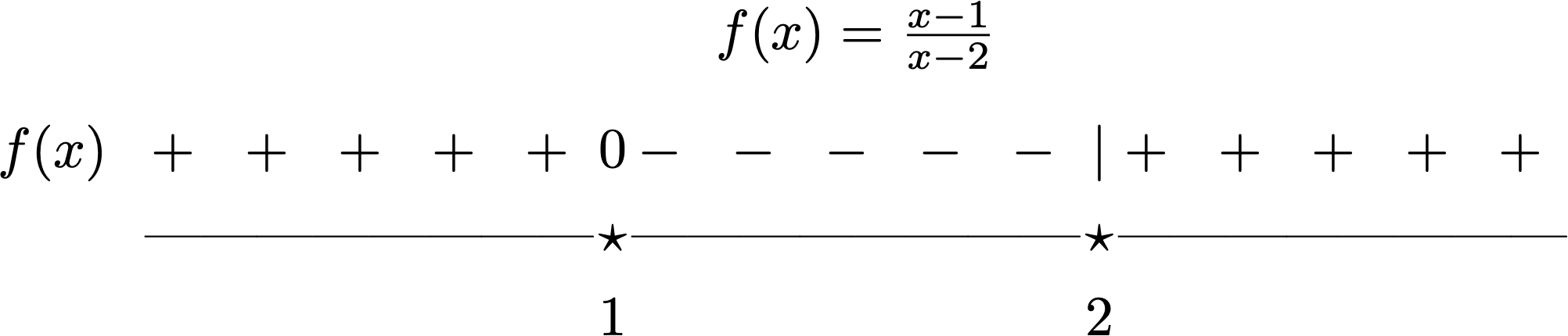
From the sign chart, we can determine that
$$\lim_{x\to2^{-}}f(x) = -\infty \quad \lim_{x\to2^{+}}f(x) = +\infty$$
We conclude that $\lim_{x\to2}f(x) = DNE$ because our right and left limits don’t match.
Let’s try another.
Example
Compute $\lim_{x \to -3^{-}} \frac{x + 2}{x^2 - 9}$ and $\lim_{x \to -3^{+}} \frac{x + 2}{x^2 - 9}$.
Once again, when we plug in $x = -3$, we get non-zero over zero:
$$\frac{(-3) + 2}{(-3)^2 - 9} = \frac{-1}{0}$$
The numerator is zero when $x = -2$. The denominator is zero when $x = \pm 3$. We’ll split our number line at $x = -3, -2, 3$. This splits the whole number line into four pieces. For each piece, we plug in one test point.

Piecewise Functions
In the previous section, we looked at looked at the limits of piecewise functions graphically. It’s not always convenient (or fun) to draw the graph of a piecewise functions just to compute one limit. We can apply the three cases we’ve looked at in this section along with what we know about one-sided limits to compute limits of piecewise functions algebraically.
Remember, $\lim_{x \to a} f(x)$ exists if and only if $\lim_{x \to a^{-}} f(x) = \lim_{x \to a^{+}} f(x)$
Example
Consider the following piecewise function.
$$ f(x) = \begin{cases} 2x - 1, & x < 1\cr x^2, & 1 \leq x < 4\cr 3\sqrt{x}, & x > 4 \end{cases} $$
Let’s evaluate the one-sided limits at $x = 1$ and $x = 4$.
- $\lim_{x \to 1^{-}}f(x) = \lim_{x \to 1^{-}}(2x - 1)$ because to the left of $1$ means $x < 1$. This is a Case 1 limit: $$\lim_{x \to 1^{-}}f(x) = \lim_{x \to 1^{-}}(2x - 1) = (2(1) -1) = \boxed{1}$$
- $\lim_{x \to 1^{+}}f(x) = \lim_{x \to 1^{+}}(x^2)$ because to the right of $1$ means $x > 1$. Since we want to be immediately to the right of $x = 1$ we use the second piece, not the third. This is also a Case 1 limit: $$\lim_{x \to 1^{+}}f(x) = \lim_{x \to 1^{+}}x^2 = (1)^2 = \boxed{1}$$
- Since $\lim_{x \to 1^{-}}f(x) = \lim_{x \to 1^{+}}f(x)$, we have $$\lim_{x \to 1}f(x) = 1$$
- $\lim_{x \to 4^{-}}f(x) = \lim_{x \to 4^{-}}(x^2)$ because to the left of $4$ means $x < 4$. Since we want to be immediately to the left of $4$, we use the second piece, not the first. This is a Case 1 limit: $$\lim_{x \to 4^{-}}f(x) = \lim_{x \to 4^{-}}x^2 = (4)^2) = \boxed{16}$$
- $\lim_{x \to 4^{+}}f(x) = \lim_{x \to 4^{+}}(x^2)$ because to the right of $4$ means $x > 4$. This is also a Case 1 limit: $$\lim_{x \to 4^{+}}f(x) = \lim_{x \to 4^{+}}3\sqrt{x} = 3\sqrt{4} = \boxed{6}$$
- Since $\lim_{x \to 4^{-}}f(x) \neq \lim_{x \to 4^{+}}f(x)$, we conclude that $$\lim_{x \to 4}f(x) \text{ DNE}$$
Other functions with vertical asymptotes
We still need to address some other functions that have vertical asymptotes:
- Trig functions: tangent, cotangent, secant, and cosecant
- Logarithmic functions
The four trig functions that have vertical asymptotes can all be rewritten in terms of sines and cosines. Once we do that, we can use or Case 2 approach.
Example
Let’s compute the right and left limits for $\tan x$ at $x = -\pi/2$.
- First, we note that $\tan x = \frac{\sin x}{\cos x}$.
- Since, $\tan x$ has infinitely many vertical asymptotes, we can’t make a complete sign chart (that would literally take forever…). Instead, we’ll identify the $x$-values where it’s either $0$ or undefined around $-\pi/2$:
- Undefined: $…,-3\pi/2, -\pi/2, \pi/2, …$
- Zero: $…,-\pi, 0, \pi, …$
- Our sign chart (or table, if you like), just needs to contain the relevant values on either side of $-\pi/2$. For our test points, we can use $-3\pi/4$ and $-\pi/4$.
- $\tan(-3\pi/4) = 1$
- $\tan(-\pi/4) = -1$
| $0$ | + + + + + + | Und | - - - - - - | $0$ |
|---|---|---|---|---|
| $-\pi$ | $-3\pi/4$ | $-\pi/2$ | $-\pi/4$ | $0$ |
Section Summary
In this section, we started by considering limits of non-piecewise functions as $x$ approaches a real value. All of these limits fall into one of three cases. We always start by trying to plug in the value that $x$ is approaching.
-
If $f(a)$ is defined, then $\lim_{x \to a} f(x) = f(a)$. So, if you can plug in $x=a$ and get a real value, you’re done!
-
If plugging in $x = a$ yields $0/0$, we try to factor and simplify. Often, simplifying will yield a Case 1 limit.
-
If plugging in $x = a$ yields $k/0$, where $k \neq 0$, then we have a vertical asymptote at $x = a$. This means that the one-sided limits must be $\pm\infty$. We can make a sign chart to determine whether the one-sided limits are positive or negative infinity.
Additional Exercises
Exercise
$$\lim_{x \to -1}\frac{x^2 - 1}{x^2 + 5x + 4}$$
Solution
Exercise
$$\lim_{x \to 2}\frac{2x^2 - x - 6}{x^2 - x - 2}$$
Solution
Exercise
$$\lim_{x \to 4}\frac{x - 4}{\sqrt{x} - 2}$$
Solution
Exercise
$$\lim_{x \to 4^{-}}{\frac{x + 1}{x - 4}}$$
Solution
Since we get $5/0$ when we plug in $x = 4$, we make a sign chart to see what happens to the left of $4$. The function is negative to the left of $4$, so we get
$$\lim_{x \to 4^{-}}{\frac{x + 1}{x - 4}} = \boxed{-\infty}$$
Exercise
$$\lim_{x \to 36^{+}}{\frac{x + 36}{\sqrt{x} - 6}}$$
Solution
At first glance, this might look like a factor-and-simplify situation, but when we plug in $x = 36$, we get $72/0$. So, we make another sign chart to see what happens to the right of $x = 36$.
To the right of $36$, the function is positive so
$$\lim_{x \to 36^{+}}{\frac{x + 36}{\sqrt{x} - 6}} = \boxed{+\infty}$$
Exercise
Consider the following piecewise function.
$$ f(x) = \begin{cases} x^3, & x \leq -1\cr 5, & -1 < x < 2\cr x^2 + 1, & x \geq 2 \end{cases} $$
Evaluate the one-sided limits at $x = -1$ and $x = 2$. Then determine if the limits at those points exist.
- $\lim_{x \to -1^{-}}f(x) = \lim_{x \to -1^{-}}x^3 = \boxed{-1}$
- $\lim_{x \to -1^{+}}f(x) = \lim_{x \to -1^{+}}5 = \boxed{5}$
- $\lim_{x \to -1}f(x)$ DNE
- $\lim_{x \to 2^{-}}f(x) = \lim_{x \to 2^{-}}5 = \boxed{5}$
- $\lim_{x \to 2^{+}}f(x) = \lim_{x \to 2^{+}}x^2 + 1 = \boxed{5}$
- $\lim_{x \to 2} f(x) = 5$.
Click here for more practice problems.