Work
Work is defined in the following way:
$$\text{Work } = \text{ Force } \cdot \text{ Displacement }$$
$$W = F \cdot d$$
Units
-
Metric: Newtons (N) $\cdot$ Meters (m) = Joules (J).
-
Imperial Units: Feet (ft.) $\cdot$ Pounds (lb.) = Foot-Pounds (ft.-lb.)
When the force being applied is constant, computing work is just simple arithmetic (multiplication). Consider the following example.
Example
In the 1976 Olympics, Vasili Alexeev astounded the world by lifting 562 lb. from the ground overhead - roughly 6.5 feet. How much work did Vasili do?
$$W = 562 \cdot 6.25 = 3512.5 \text{ft.-lb.}$$
Non-constant Force
If the force being applied varies, we need calculus to compute work. For most applications, the force will be a function of displacement. We’ll add up little slices or work by integrating. If the force applied from $x=a$ to $x=b$ is given by $F(x)$, then the work done is given by the following definite integral:
$$\text{Work: } \int_a^b F(x) \ dx$$
Notice: [we’re not integrating]{.underline} $F(x)\cdot x$. The displacement is captured by the $dx$ term.
Example: Hooke’s Law
Consider a spring that exerts a force of 6 N when stretched 2 m beyond its natural length.
-
Find the spring constant $k$.
-
How much work is required to stretch the spring 4 m beyond its natural length.
Hooke’s Law tells us that the force exerted by stretching a spring $x$ units beyond its natural length is given by
$$F( x ) = kx$$
The units for $k$ depend on the units of distance we’re using.
-
If $x$ is in ft., $k$ is in lb./ft.
-
If $x$ is in m, $k$ is in N/m.
Part (a): In this case, we know that $F(2) = 6$. This means that $k(2) = 6$, so $k = 3$.
$$F(x) = 3x$$
Part (b): To compute the work required to stretch the spring 4 m beyond its natural length we need to integrate our newly found force function from $x = 0$ to $x = 4$:
$$\begin{aligned} W &= \int_0^4 3x \ dx \cr &= \frac32 x^2 \biggr \rvert_0^4 \cr &= \frac32 \left(16 - 0\right) \cr &= \boxed{24 \ \text{J}} \end{aligned}$$
Example: A Lifting Problem
Suppose a load of 1000 lb. of iron ore is lifted up a 100 ft. mineshaft by a steel cable weighing 2 lb./ft. How much work is requited to lift the ore up the mineshaft?
First, we should draw a diagram with a labeled $x$-axis:
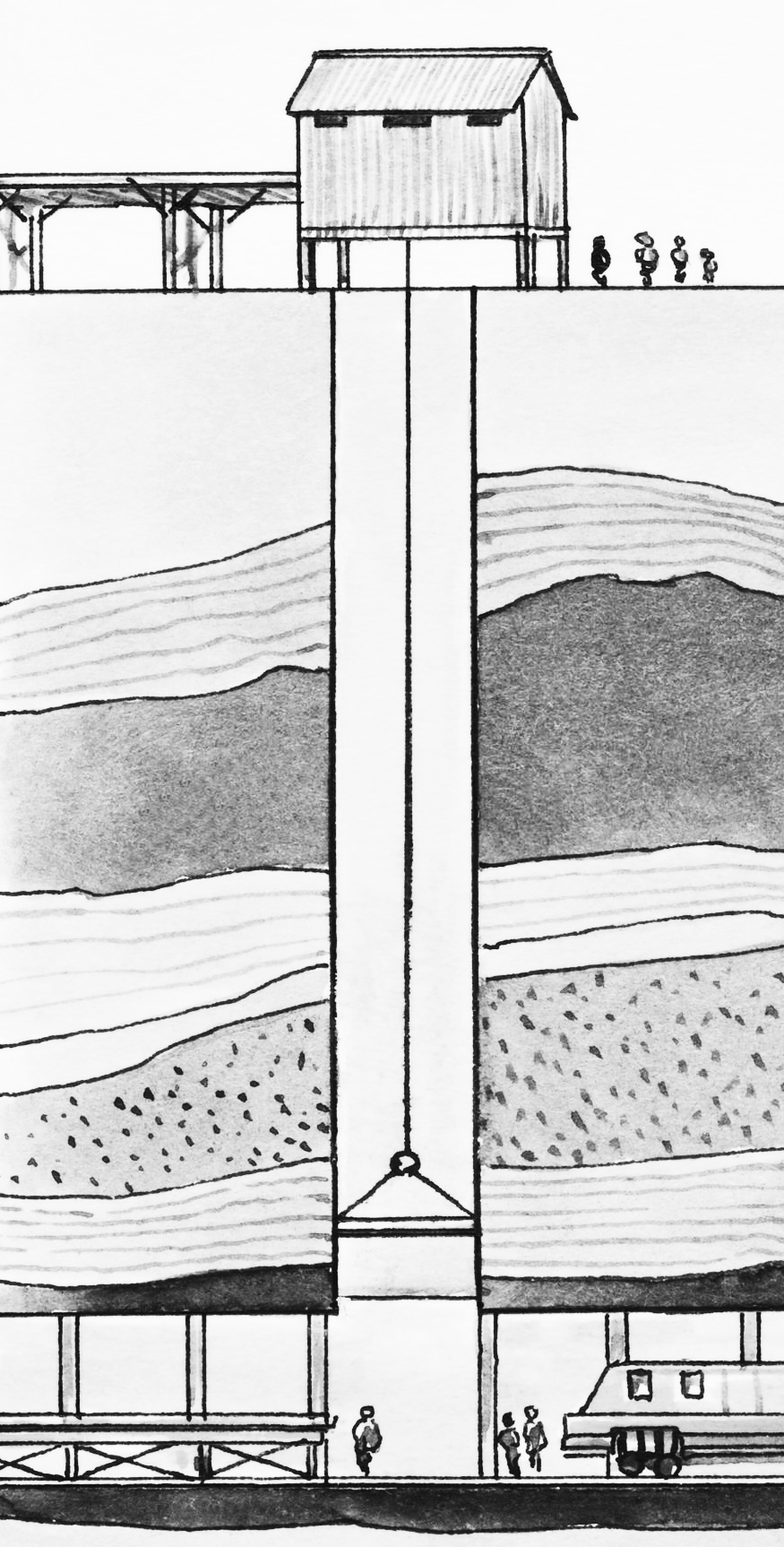
The force/weight here is given by the sum of the weights of the ore and the cable.
-
The ore weighs a constant 1000 lb.
-
The cable wights 2 lb./ft., so if there are $100-x$ ft. left when we’re at a height of $x$ ft., the cable weights $2(100-x)$ lb.
Therefore,
$$\begin{aligned} \text{Work: } &= \int_0^{100} \left(1000 + 2(100 - x)\right)\ dx \cr &= \boxed{110000 \text{ ft.-lb.}} \end{aligned}$$
Example: Pumping Problem
A conical water tank has a height of 20 m and a radius of 5 m (at the top). The tank is filled to a depth of 10 m. How much work is required to pump the water out through the top of the tank?
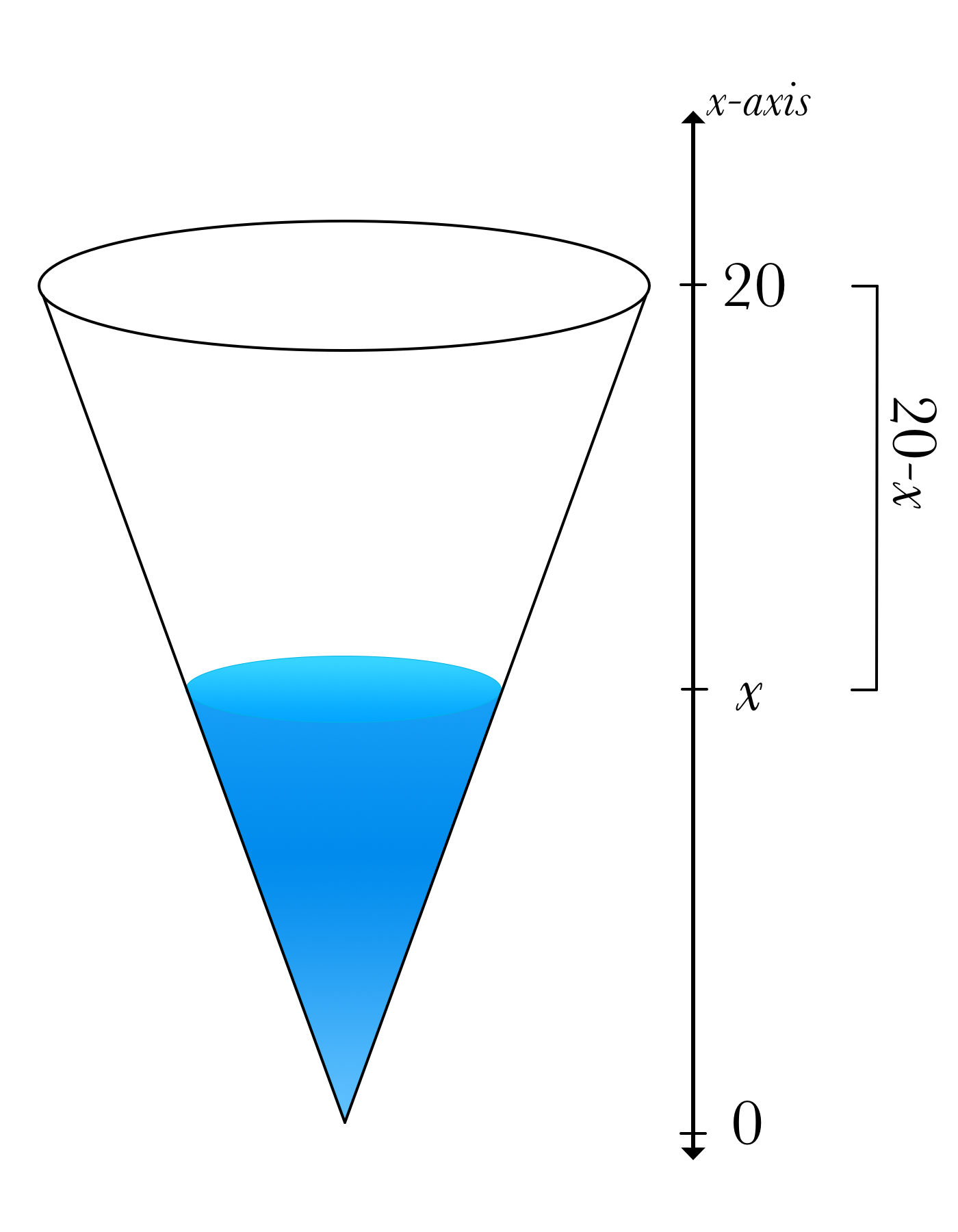
For pumping problems, the force function can be quite tricky. It’s helpful to think about moving the liquid in “slices.” Each slice, in this case, is a thin cylinder. The height of the cylinder is $dx$. The volume of each cylinder is $V = \pi r^2 h = \pi r^2 dx$
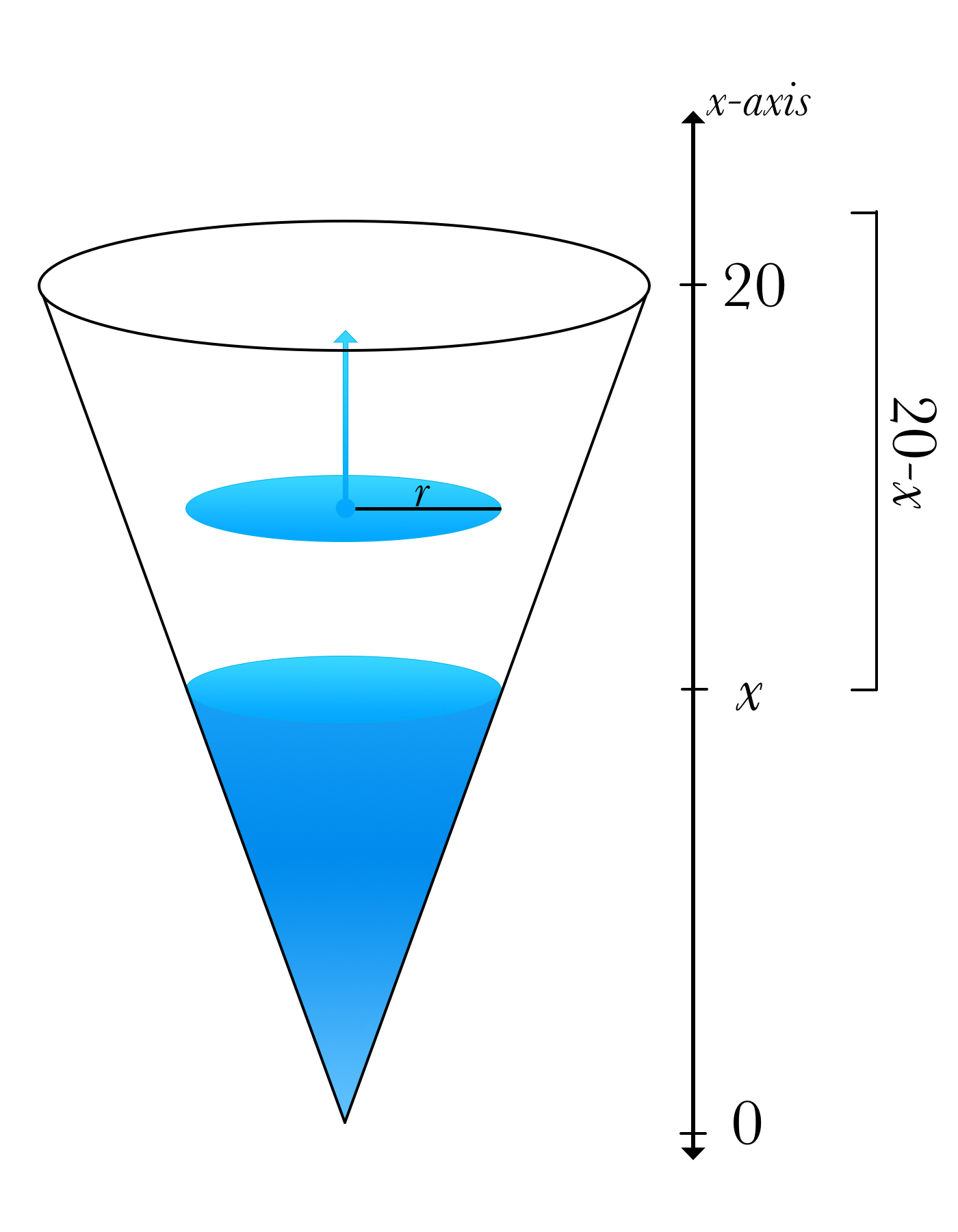
We need $r$ in terms of $x$. By similar triangles, we have $r/x = 5/20$, so $r = \frac14x$. Each slice moves $20 - x$ m.
$$\text{Work: } \int_0^{10} 9810\pi\frac{1}{16}x^2(20 - x)\ dx$$
Exercise: Spring Problem
A spring whose natural length is 15 cm exerts a force of 45 N when stretched to a length of 20 cm.
- Find the spring constant (in newtons/meter).
- Find the work that is done in stretching the spring 3 cm beyond its natural length.
- Find the work done in stretching the spring from a length of 20 cm to a length of 25 cm.
Solution
Find the spring constant (in newtons/meter).
Because the natural length of the spring is 15 cm, a length of 20 cm corresponds to a displacement of 5 cm beyond the natural length.
$$F(5) = k(5) = 45$$
So, $k = 9$ N/cm or $900$ N/cm
Find the work that is done in stretching the spring 3 cm beyond its natural length.
$$ \begin{aligned} W &= \int_0^3 9x \ dx \cr &= \frac92 x^2 \biggr \rvert_0^3 \cr \frac{81}{2} \end{aligned} $$
The work that is done in stretching the spring 3 cm beyond its natural length is $\frac{81}{2}$ N $\cdot$ cm or, by multiplying by $\frac{1\text{ m}}{100\text{ cm}}$, we get $\frac{81}{200}$ J
Find the work done in stretching the spring from a length of 20 cm to a length of 25 cm.
$$\begin{aligned} W &= \int_5^{10} 9x \ dx \cr &= \frac92 x^2 \biggr \rvert_5^{10} \cr &= \frac{675}{2} \end{aligned}$$
The work that is done in stretching the spring from a length of 20 cm to a length of 25 cm is $\frac{675}{2}$ N $\cdot$ cm or $\frac{675}{200}$ J
Exercise: A Lifting Problem
Suppose a load of 500 lb. of iron ore is lifted up a 200 ft. mineshaft by a steel cable weighing 4 lb./ft. How much work is requited to lift the ore up the mineshaft?
Solution
Exercise: Pumping Problem
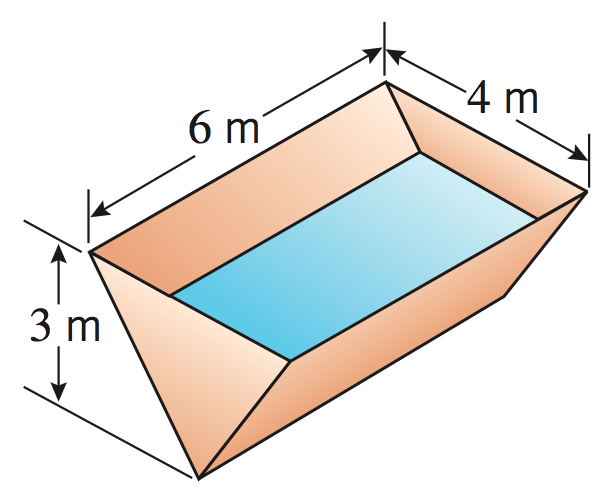
The vat shown in the accompanying figure contains water to a depth of 2 m. Find the work required to pump all the water to the top of the vat. [Use 9810 N/m$^3$ as the weight density of water.]
Solution
The “slices” of water in this problem are rectangular. So, the volume of each is $V = lwh$. Once again, we use $dx$ for the height. The length is $6$ m. What we need is the width as a function of $x$. We can use similar triangles to get this:
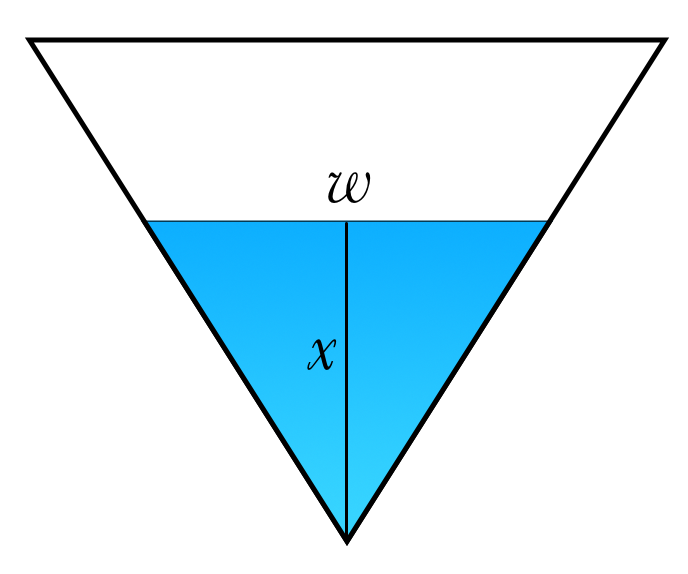
We see that $\frac{w}{x} = \frac43$, so $w = \frac43 x$.
The volume of each “slice” is then $6\left(\frac43 x\right)dx = 8x\ dx$ To get weight, we just multiply this volume by the weight-density of water.
We also need the displacement of each slice: $(3 - x)$.
$$ \begin{aligned} W &= \int_0^2 9810 \cdot 8x(3-x) \ dx\cr &= \boxed{261600 \text{ J}} \end{aligned} $$