Area as a Limit
In the first few chapters, we learned how to compute limits and then applied that knowledge to answer a key question: how do we compute the instantaneous rate of change (or the slope of the tangent line) for a function at a given point? This gave rise to the concept of the derivative and a whole bunch of applications - related rates, analysis of functions, optimization.
Now we’re going to switch gears and turn to another question: how do we compute the exact area bounded between a continuous function and the $x$-axis? As it turns out, limits are going to be the tool we use to answer this question as well. Just as before, once we can answer this question, we’ll be able to apply that new knowledge to a whole host of applications.
From approximation to exact answer
To answer the instantaneous rate of change/tangent line question, we did something like this:
- Start with the average rate of change or slope of a secant line for $f$ at $x=a$:
$$ \frac{f(b) - f(a)}{b - a} $$
- If $a$ and $b$ are close together, this is a decent approximation of the slope of the tangent line at $x=a$. To make it exact, we take a limit:
$$ \lim_{ b \to a } \frac{f(b) - f(a)}{b - a} $$ So, our process could be summarized like this:
- Start with an approximation
- Take a limit
- Get the exact answer
We can do the exact same thing to answer the area question. First, though, we need to find an easy-to-compute approximation of the area under a curve.
What’s the easiest shape to compute area for?
A rectangle: Area = Base $\cdot$ height
What if we chop the area we’re looking for up into a bunch of rectangles? Let’s try it with a specific function.
Example
Consider the function $f(x) = x^2$ on the interval $[0,4]$. Let’s chop up the area under the parabola and above the $x$-axis using four rectangles. To make things simple, we’ll make each rectangle the same width and we’ll make the top-right corner of each rectangle go up to the curve.
If we’re dividing the interval $[0,2]$ into four equal segments, each segment has a width of $1/2$ since $\frac{2-0}{4} = \frac{1}{2}$.
To get the width of each rectangle, we computed $\frac{\text{length of interval}}{\text{number of rectangles}}$
Our picture looks like this:

To get an approximation of this area, we just add up the areas of the four rectangles.
- Each has a width of $1/2$
- The heights are determined by the $f$-values (or $y$-values)
$$ \begin{aligned} A &\approx \frac{1}{2}f\left( \frac{1}{2} \right) + \frac{1}{2}f(1) + \frac{1}{2}f\left( \frac{3}{2} \right) + \frac{1}{2}f(2) \cr &\approx \frac{1}{2}\left(f\left( \frac{1}{2} \right) +f(1) + f\left( \frac{3}{2} \right) +f(2)\right) \cr &\approx \frac{1}{2} \left( \frac{1}{4} + 1 + \frac{9}{4} + 4 \right) \cr &\approx \frac{1}{2}\left( \frac{30}{4} \right) \cr &\approx \boxed{\frac{15}{4}} \end{aligned} $$ Our approximate area is $15/4$. We can see from the picture that this is an overestimate. If we had used more rectangles, we would have gotten a better approximation.
The more rectangles we use, the better our approximation gets. Why not let the number of rectangles go to infinity? Sounds a lot like a limit problem…
This raises another question: how do we work with infinite sums?
Sigma Notation
To work with infinite sums, we’re going to need some new notation: sigma notation. The general form looks like this:
$$ \boxed{\sum_{k=1}^nf(k) = f(1) + f(2) + f(3) + \cdots + f(n)} $$ A few things to note:
- We call $k$ the “index.”
- You can use any letter you like for an index, but people often use $i$, $j$, or $k$.
- The index can only take on integer values - no fractions
- Under the sigma, we indicate the first value for the index. In this case $k$ starts at $1$
- The value we place on top - in this case I used $n$ - is the upper bound. This is the last value we plug into $f$
Here’s a more concrete example:
Example
$$ \begin{aligned} \sum_{k=1}^7 (2n + 1) &= (2(1) + 1) + (2(2) + 1) + (2(3) + 1) + (2(4) + 1) + (2(5) + 1) + (2(6) + 1) + (2(7) + 1) \cr &= 3 + 5 + 7 + 9 + 11 + 13 + 15 \cr &= \boxed{63} \end{aligned} $$
You try:
Exercise
$$
\sum_{k=1}^5 (k^2)
$$
Solution
The purpose of sigma notation isn’t to write sums of five or six or seven numbers but to write very large sums - sums you wouldn’t even want to type out into a calculator. Something like this:
$$ \sum_{k=1}^{25} (2k^2 - 4) $$ Writing out all of these terms and computing them by hand would be incredibly tedious. We need some shortcuts.
Summation Formulas
Let’s start with an easy one:
$$ \sum_{k=1}^n 1 = \underbrace{1 + 1 + 1 + \cdots + 1}_{n \text{ times}} = n $$ Since we’re just adding $1$ to itself $n$ many times, the sum is just $n$. So,
$$ \sum_{k=1}^{34} 1 = 34 $$ How about something like this:
$$ \sum_{k=1}^n k = 1 + 2 + 3 + \cdots + (n-2) + (n-1) + n $$ This is the sum of the first $n$ integers/whole-numbers. This one requires some clever maneuvering. We’re going to add the sum to itself, but write the terms in reverse order.
$$ \begin{aligned} \sum_{k=1}^n k &= 1 + 2 + 3 + \cdots + (n-2) + (n-1) + n \cr \sum_{k=1}^n k &= n + (n-1) + (n-2) + \cdots + 3 + 2 + 1 & \boxed{\text{add these}}\cr 2\sum_{k=1}^n k &= {(n+1) + (n+1) + (n+1) + \cdots + (n+1) + (n+1) + (n+1)} \cr 2\sum_{k=1}^n k &= n(n+1) \cr \sum_{k=1}^n k &= \frac{n(n+1)}{2} \end{aligned} $$
Okay! We found a summation formula that allows us to quickly compute sums that fit this form:
$$ \boxed{\sum_{k=1}^n k = \frac{n(n+1)}{2}} $$ Let’s apply it:
Example
$$ \begin{aligned} \sum_{k=1}^{22} k &= 1 + 2 + 3 + \cdots + 22 & \boxed{\text{ no need to write this out}} \cr &= \frac{22(22+1)}{2} \cr &= \frac{22(23)}{2}\cr &= \boxed{253} \end{aligned} $$
You try:
Exercise
$$ \sum_{k=1}^{50} k $$
Solution
There are two more summation formulas we’ll add to our list. We won’t prove these here, but I’ll like to the proofs in case you’re interested:
Summation Formulas
$$\sum_{k=1}^n 1 = n$$ $$\sum_{k=1}^n k = \frac{n(n+1)}{2}$$ $$\sum_{k=1}^n k^2 = \frac{n(n+1)(2n+1)}{6}$$ $$\sum_{k=1}^n k^3 = \left( \frac{n(n+1)}{2} \right)^{2}$$
In addition to these summation formulas, there are several important properties of sums that we’ll need.
Properties of Sums
Consider the sum $\sum_{k=1}^n(f(k) + g(k))$.
$$ \begin{aligned} \sum_{k=1}^n(f(k) + g(k)) &= (f(1) + g(1)) + (f(2) + g(2)) + \cdots + (f(n) + g(n)) \cr \end{aligned} $$ Since the order in which we add numbers doesn’t matter, we can rearrange the sum like this:
$$ \begin{aligned} \sum_{k=1}^n(f(k) + g(k)) &= (f(1) + g(1)) + (f(2) + g(2)) + \cdots + (f(n) + g(n)) \cr &= \underbrace{f(1) + f(2) + \cdots f(n)} + \underbrace{g(1) + g(2) + \cdots g(n)} \cr &= \sum_{k=1}^n f(k) + \sum_{k=1}^n g(k) \end{aligned} $$
How about $\sum_{k=1}^n af(k)$?
$$ \begin{aligned} \sum_{k=1}^n af(k) &= af(1) + af(2) + \cdots + af(n) & \boxed{\text{ factor out $a$}} \cr &= a(f(1) + f(2) + \cdots + f(n)) \cr &= a\sum_{k=1}^n f(k) \end{aligned} $$
Properties of Sums
Sum of sums property: $$\sum_{k=1}^n(f(k) + g(k)) = \sum_{k=1}^n f(k) + \sum_{k=1}^n g(k)$$ Factoring property: $$\sum_{k=1}^naf(k) = a\sum_{k=1}^n f(k)$$
Example
Let’s go back to the sum we looked at earlier and see if we can apply all of the properties and formulas we’ve figured out so far.
$$ \begin{aligned} \sum_{k=1}^{25} (2k^2 - 4) &= \sum_{k=1}^{25} 2k^2 - \sum_{k=1}^{25} 4 & \boxed{\text{apply the sum property}} \cr &= 2\sum_{k=1}^{25} k^2 - 4\sum_{k=1}^{25} 1 & \boxed{\text{ready to apply our formulas}} \cr &= 2\left( \frac{(25(25+1)(2(25)+1))}{6} \right) - 4(25) \cr &= 2\left( \frac{(25(26)(51)}{6} \right) - 4(25) \cr &= \boxed{10950} \end{aligned} $$
Exercise
Try this one.
$$ \sum_{k=1}^{18}(4k + 1) $$
Solution
Exercise
One more.
$$ \sum_{k=1}^{14}(k^2 - 2k) $$
Solution
Changing Index
What happens if we encounter a sum that doesn’t start the index at $1$?
$$ \sum_{k=4}^{12} k $$ We can’t use the summation formula directly! But we’ve got a couple options.
Option 1: Split the formula
We can split the formula into two sums:
$$ \begin{aligned} \sum_{k=1}^{12} k &= \underbrace{1 + 2 + 3} + \underbrace{4 + 5 + 6 + 7 + 8 + 9 + 10 + 11 + 12} \cr \sum_{k=1}^{12} k &= \sum_{k=1}^{3}k + \sum_{k=4}^{12}k & \boxed{\text{solve for the sum we want}} \cr \sum_{k=4}^{12}k &= \sum_{k=1}^{12} k - \sum_{k=1}^{3}k &\boxed{\text{use the formulas now}} \cr &= \frac{12(13)}{2} - (1 + 2 + 3) &\boxed{\text{for small sums, just add ’em up}} \cr &= \boxed{72} \end{aligned} $$
Option 2: Change the index
Another option is to change or shift the index values. Whatever changes we make to the index values, we have to account for in the function we’re summing.
$$ \begin{aligned} \sum_{k=4}^{12} k &= \sum_{k=4-3}^{12-3} (k+3) \cr &= \sum_{k=1}^{9} (k+3) \cr &= \sum_{k=1}^{9} k + \sum_{k=1}^{9} 3 \cr &= \frac{9(10)}{2} + 3(9) \cr &= \boxed{72} \end{aligned} $$
Let’s take all of this back to the area problem.
Areas with Summation Notation
Example
Consider the function $f(x) = x^2$ on the interval $[0,4]$. Let’s split this up into $n$ rectangles of equal width, and use the right side of each rectangle to determine the height.
Our goal is to set up a sum that takes this form: $$ \sum_{k=1}^n(\text{heights})(\text{widths}) $$ We want $k$ to start at $1$ for two reasons: (1) to be able to use the summation formulas directly and (2) so that it counts the rectangles for us.
We’ll call the width of each rectangle $\Delta x$.
$$ \begin{aligned} \Delta x &= \frac{\text{length of interval}}{\text{number of rectangles}} \cr &= \frac{2 - 0}{n} \cr &= \frac{2}{n} \end{aligned} $$ Since $f$ gives us the heights, we need a formula for the $x$-values we’ll be plugging into $f.$ We start at $0$ and hop forward in increments of $\Delta x$. We’re going to call the $x$-values where we land $x_k^{*}$.
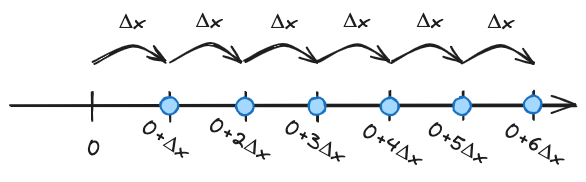
We don’t use $0$ because it’s a left endpoint (left side of the first rectangle).
Let’s see what the pattern is here:
$$ x_1^{} = \Delta x, x_2^{} = 2\Delta x, x_3^{} = 3\Delta x, \dots, x_k^{} = k\Delta x $$ So, the $k$-th term is $k\Delta x$. The height of the $k$-th rectangle must be
$$ f(x_{k}^{*}) = (k\Delta x)^2 = \left( k \frac{2}{n} \right)^2 = \frac{4k^2}{n^2} $$
Our approximate area with $n$ rectangles is given by
$$ \sum_{k=1}^n\left( \frac{4k^2}{n^2} \right)\left( \frac{2}{n} \right) $$ Let’s simplify this and then apply the properties and formulas we derived above.
$$ \begin{aligned} \sum_{k=1}^n\left( \frac{4k^2}{n^2} \right)\left( \frac{2}{n} \right) &= \sum_{k=1}^n\left( \frac{8k^2}{n^3} \right) \cr &= \frac{8}{n^3}\sum_{k=1}^n k^2 &\boxed{\text{we can factor out any non-$k$ term}} \cr &= \frac{8}{n^3}\frac{(n(n+1)(2n+1))}{6} \cr &= \frac{8}{n^3}\frac{2n^3 + 3n^2 + n}{6} \cr &= 8\frac{2n^3 + 3n^2 + n}{6n^3} \cr \end{aligned} $$ This would give us the approximate area using $n$ rectangles (for any value of $n$). We want to take the limit as $n\to\infty$:
$$ \begin{aligned} A &= \lim_{ n \to \infty } 8\frac{2n^3 + 3n^2 + n}{6n^3} \cr &= 8\left( \frac{1}{3} \right) \cr &= \boxed{\frac{8}{3}} \end{aligned} $$
Summary of Riemann Sums
If $f$ is continuous on $[a,b]$, then the net-signed area between the graph of $f$ and the $x$-axis over $[a,b]$ is given by
$$\lim_{ n \to \infty } \sum_{k=1}^n f(x_{k}^{*}) \Delta x$$
where $\Delta x = \frac{b-a}{n}$ and $x_k^{*}$ can be defined be defined as follows:
- Left endpoints: $x_k^{*} = a + (k-1)\Delta x$
- Right endpoints: $x_k^{*} = a + k\Delta x$
- Midpoints: $x_k^{*} = a + \left( k-\frac{1}{2} \right)\Delta x$
We refer to this as a Riemann Sum.
Note: We’ll clarify what we mean by net-sign area in the next section.
Exercise
Use a Riemann sum with right-endpoints to compute the exact area between $f(x) = 4 - x^2$ and the $x$-axis over $[0,1]$.
Solution
We start by assembling the pieces we need:
- Widths: $\Delta x = \frac{1-0}{n} = \boxed{\frac{1}{n}}$
- Right endpoints: $x_k^{*} = 0 + k\Delta x = \boxed{\frac{k}{n}}$
- Heights:
$$ \begin{aligned} f( x_{k}^{*} ) &= 4 - (x_{k}^{*})^2 \cr &= 4 - \left( \frac{k}{n} \right)^2 \cr &= \boxed{4 - \frac{k^2}{n^2}} \end{aligned} $$
- Putting it all together:
$$ \begin{aligned} A &= \lim_{ n \to \infty } \sum_{k=1}^n \left( 4 - \frac{k^2}{n^2} \right)\left( \frac{1}{n} \right) \cr &= \lim_{ n \to \infty } \sum_{k=1}^n \left( \frac{4}{n} - \frac{k^2}{n^3} \right) \cr &= \lim_{ n \to \infty } \left[ \sum_{k=1}^n \left( \frac{4}{n} \right) - \sum_{k=1}^n \left(\frac{k^2}{n^3} \right) \right] \cr &= \lim_{ n \to \infty } \left[ \frac{4}{n}\sum_{k=1}^n 1 - \frac{1}{n^3}\sum_{k=1}^n k^2 \right] \cr &= \lim_{ n \to \infty } \left[ \frac{4}{n}(n) - \frac{1}{n^3} \frac{2n^3 + 3n^2 + n}{6} \right] \cr &= \lim_{ n \to \infty } \left[ 4 - \frac{2n^3 + 3n^2 + n}{6n^3} \right] \cr &= 4 - \frac{1}{3} \cr &= \boxed{\frac{11}{3}} \end{aligned} $$