Rates of Change
In this section, we are going to use limits to compute the instantaneous rate of change of a function at a given point. So, given a function, $f$, and an $x$-value, $a$, we will find the instantaneous rate of change of $f$ at $x=a$. The same value will also be the slope of the tangent line to the graph of $f$ at the point $(a,f(a)).$
Before starting this section, make sure you’re comfortable solving Case 2 limits (those that give us $0/0$).
By the end of this section, you should
- Be able to compute the instantaneous rate of change of a function at a given point
- Be able to write an equation for the line tangent to the graph of a function at a given point
- Know how instantaneous rate of change is related to the slope of a tangent line
Types of Rates of Change
The first important distinction we want to make is between average rate of change and instantaneous rate of change. Suppose I drive from Philadelphia to Pittsburg. The distance is about 327 miles. If it takes me $6.5$ hours. What was my average speed?
Solution
Average speed is given by $\frac{\text{Distance}}{\text{Time}}$. So, in my case
$$\boxed{\text{Avg. Speed } = \frac{327}{\text{6.5}} \approx 50.3 \text{ mi/hr}}$$
Now that $50$ mi/hr (or mph) isn’t particularly descriptive with regard to my driving habits. Maybe I really did drive around $50$ mph for most of my trip. Maybe I stopped for $45$ minutes and the floored it for an hour to make up the time.
If you want a better moment-to-moment description, you want my instantaneous rate of change.
Instantaneous rate of change is what your speedometer tells you at each moment.
The question for us is, *how do we get the instantaneous rate of change of a function at a particular point?
Let’s start with a more thorough look at average rate of change.
Average Rate of Change of a Function
To get the average rate of change of $f$ from $x = a$ to $x = b$, we compute the following ratio:
$$\text{Avg. Rate of Change } = \frac{f(b) - f(a)}{b - a} \text{ or } \frac{\Delta f}{\Delta x}$$
Let’s try an example.
Example
What’s the average rate of change for $f(x) = \frac1x$ over $[1,4]$ (meaning from $x = 1$ to $x = 4$)?
Well, in this case our $a = 1$ and our $b = 4$. This gives us
$$ \begin{aligned} \frac{f(b) - f(a)}{b - a} &= \frac{f(4) - f(1)}{4 - 1}\cr &= \frac{\frac14 - \frac11}{4 - 1}\cr &= \frac{-\frac34}{3}\cr &= \boxed{-\frac14} \end{aligned} $$
So the average rate of change for $f$ over $[1,4]$ is $-1/4$.
What does this correspond to visually?
Solution
The formula $\frac{f(b) - f(a)}{b - a}$ should look very familiar. You may have first learned it as
$$\frac{y_2 - y_1}{x_2 - x_2} \text{ or } \frac{\Delta y}{\Delta x} \text { or } \frac{\text{rise}}{\text{run}}$$
It’s the slope formula! In this case it’s the slope of the line connecting two points on the graph of $f$ - we call this a secant line.
If we want to write an equation for the secant line to $f$ from $x = 1$ to $x = 4$, we need two things:
- The slope: we’ve got that already. It’s $-1/4$.
- A point on the line: we have two to pick from. Since $f(1) = 1$, we have the point $(1,1)$. Or, since $f(4) = 1/4$, we also have $(4,1/4)$.
Secant line:
$$ \begin{aligned} y - y_1 &= m(x - x_1)\cr y - (1) &= \left(-\frac14\right)(x - (1))\cr y - 1&= -\frac14 x + \frac14\cr y &= -\frac14 x + \frac54 \end{aligned} $$

Exercise
Compute the average rate of change for $g(x) = x^2 - 2x$ over $[-1,4]$, and use that answer to write an equation for the secant line from $x = -1$ to $x = 4$.
Solution
Average rate of change:
$$ \begin{aligned} \frac{g(4) - g(-1)}{4 - (-1)} &= \frac{8 - 3}{4 + 1}\cr &= \frac{5}{5}\cr &= \boxed{1} \end{aligned} $$
For the secant line, we can either use point-slope form or slope-intercept. Either way, we need a point on the line. Let’s take $x = -1$. For the corresponding $y$-value, we get
$$y = g(-1) = (-1)^2 - (2)(-1) = 3$$
So, our point is $(-1,3)$.
To use point-slope form, we’ll plug in $x_1 = -1$, $y_1 = 3$, and $m = 1$.
$$ \begin{aligned} y - y_1 &= m(x-x_1)\cr y - (3) &= (1)(x - (-1))\cr y - 3 &= x + 1\cr y &= x + 4 \end{aligned} $$
If we want to use slope-intercept form, we plug in $x = -1$, $y = 3$, and $m = 1$ and the solve for $b$:
$$ \begin{aligned} y &= mx + b\cr 3 &= (1)(-1) + b\cr 3 &= -1 + b\cr 4 &= b\cr y &= x + 4 \end{aligned} $$
You should use whichever approach you’re most comfortable with.
Exercise
Compute the average rate of change for $h(x) = \sqrt{2x}$ over $[0,8]$, and use that answer to write an equation for the secant line from $x = 0$ to $x = 8$
Solution
Average rate of change:
$$ \begin{aligned} \frac{h(8) - h(0)}{8 - 0} &= \frac{\sqrt{2(8)} - \sqrt{2(0)}}{8 - 0}\cr &= \frac{\sqrt{16} - \sqrt0}{8 - 0}\cr &= \frac{4 - 0}{8 - 0}\cr &= \frac48\cr &= \boxed{\frac12} \end{aligned} $$
We have our slope: $m = 1/2$. For our point, let’s use $x = 0$:
$$y = h(0) = \sqrt0 = 0$$
Secant line:
$$ \begin{aligned} y - y_1 &= m(x - x_1)\cr y - 0 &= \frac{1}{2}(x - 0)\cr y &= \frac12 x \end{aligned} $$
Instantaneous Rate of Change
Now that we know how to compute the average rate of change for a function, how do get the instantaneous rate of change at a point? To answer this question we’re going to have to think in terms of limits.
Going from average to instantaneous
Consider the driving example from before. My average speed $50.3$ mph was the average over several hours. That doesn’t tell us much about the way I drive. I could go really fast and then really slow and end up with an average of $50.3$ mph. Or, I could drive $50.3$ mph most of the time.
But, what if I told you my average speed over $1$ minute? Or over $3$ seconds? Or over $0.01$ seconds? The average over a very short period of time like that would probably be very close to my speedometer said during that time, right?
We know how to compute the average rate of change of a function $f$ from $x = a$ to $x = b$. What if we move $b$ closer and closer to $a$? What if we ask what happens as $b \to a$? This is where limits come in.
The Limit Definition of Instantaneous Rate of Change
Let’s take our average rate of change formula $\frac{f(b) - f(a)}{b - a}$ and apply the limit as $b \to a$:
$$ \text{Instantaneous Rate of Change: } \boxed{\lim_{b \to a}\frac{f(b) - f(a)}{b - a}} $$
This formula does exactly what we want, but we can make it a little easier to use.
- Let $h = b - a$.
- If $h = b - a$, we can also say $b = a + h$.
- Then, as $b \to a$, $h \to a - a$, so $h \to 0$.
Let’s substitute all that in our formula.
$$ \lim_{b \to a}\frac{f(b) - f(a)}{b - a} = \lim_{h \to 0}\frac{f(a+h) - f(a)}{h} $$
All we did was make the following substitutions/replacements:
- $b - a$ became $h$
- $b$ became $a + h$.
- $b \to a$ became $h\to 0$
All of Calc 1 or Differential Calculus boils down to this formula and everything that follows from it.
Computing Instantaneous Rate of Change
The instantaneous rate of change for $f$ at $x = a$ is given by
$$\lim_{h \to 0}\frac{f(a +h) - f(a)}{h}$$
Example
We found that the average rate of change for $f(x) = \frac1x$ from $x = 1$ to $x = 4$ is $-1/4$.
Now, let’s compute the instantaneous rate of change for $f(x)$ at $x = 1$.
- We have $a = 1$.
- $$f(a) = f(1) = \frac11 = 1$$
- $$f( a + h ) = f(1 + h) = \frac{1}{1 + h}$$
Putting it all together, we get
$$ \begin{aligned} \lim_{h \to 0}\frac{f(a +h) - f(a)}{h} &= \lim_{h \to 0}\frac{\frac{1}{1 + h} - 1}{h} \leftarrow \star\cr &= \lim_{h \to 0}\frac{\frac{1}{1 + h} - \frac{1 + h}{1 + h}}{h} \leftarrow \dagger\cr &= \lim_{h \to 0}\frac{\frac{1 - (1 + h)}{1 + h}}{h}\cr &= \lim_{h \to 0}\frac{\frac{-h}{1 + h}}{h}\cr &= \lim_{h \to 0}\frac{-1}{1 + h}\cr &= \frac{-1}{1 + (0)}\cr &= \frac{-1}{1}\cr &= \boxed{-1} \end{aligned} $$
Notes:
$\star$ : Notice this is a Case 2 limit; we get $0/0$
$\dagger$ : We get a common denominator for $\frac{1}{1 + h}$ and $1$; $1$ becomes $\frac{1+h}{1+h}$.
From there, we simplify as much as possible until we eventually get a Case 1 limit.
Exercise
Use the limit definition to compute the instantaneous rate of change of $x^2 + x$ at $x = 2$.
Solution
Our $a$-value is $2$:
- Let’s first simplify $f(2 + h)$ as much as possible
$$ \begin{aligned} f(x) &= x^2 + x\cr f(2 + h) &= (2+h)^2 + (2 + h)\cr &= (4 + 4h + h^2) + 2 + h\cr &= 6 + 5h + h^2 \end{aligned} $$
- We can also simplify $f(2) = (2)^2 + (2) = 6$.
$$ \begin{aligned} \lim_{h \to 0}\frac{f(a+h) - f(a)}{h} &= \lim_{h \to 0}\frac{f(2+h) - f(2)}{h}\cr &= \lim_{h \to 0}\frac{(6 + 5h + h^2) - (6)}{h}\cr &= \lim_{h \to 0}\frac{5h + h^2}{h}\cr &= \lim_{h \to 0}\frac{h(5 + h)}{h}\cr &= \lim_{h \to 0}(5 + h)\cr &= 5 + (0)\cr &=\boxed5 \end{aligned} $$
With average rate of change, we had corresponding visual representation: the slope of the secant was the average rate of change. To get the instantaneous rate of change, we shrank the distance between $a$ and $b$. What happens to the picture as we do that, as $b - a \to 0$? Move the right point toward the left by clicking and dragging the red point.
The closer $b$ gets to $a$, the more the secant line begins to look tangent to the graph of $f$!
Slope of a tangent line
The instantaneous rate of change of $f$ and $x = a$ is also the slope of the line tangent to the graph of $f$ at $x = a$.
Example
Let’s find an equation for the line tangent to $f(x) = \sqrt{x}$ at $x = 4$. To do so, we’ll compute the instantaneous rate of change of $f$ at $x = 4$, which will give us the slope.
First, we’ll simplify $f(4 + h)$ and $f(4)$:
- $f(4 + h) = \sqrt{4 + h}$
- $f(4) = \sqrt4 = 2$
$$ \begin{aligned} \lim_{h \to 0}\frac{f(a+h) - f(a)}{h} &= \lim_{h \to 0}\frac{\sqrt{4 + h} - 2}{h} \end{aligned} $$
What do we do now?
Let’s multiply by the conjugate of the numerator: $\frac{\sqrt{4+h} + 2}{\sqrt{4+h} + 2}$
$$ \begin{aligned} \lim_{h \to 0}\frac{f(a+h) - f(a)}{h} &= \lim_{h \to 0}\frac{\sqrt{4 + h} - 2}{h} \cdot \frac{\sqrt{4+h} + 2}{\sqrt{4+h} + 2}\cr &= \lim_{h \to 0}\frac{(4 + h) - (4)}{h(\sqrt{4 + h} + 2)}\cr &= \lim_{h \to 0}\frac{h}{h(\sqrt{4 + h} + 2)}\cr &= \lim_{h \to 0}\frac{1}{\sqrt{4 + h} + 2}\cr &= \frac{1}{\sqrt{4 + (0)} + 2}\cr &= \frac{1}{2 + 2}\cr &= \boxed{1/4} \end{aligned} $$
So, our slope is $m = 1/4$.
We also need a point on the line. Plugging $x = 4$ into $f$, we get $f(4) = \sqrt4=2$.
Our point is $(4,2)$.
$$ \begin{aligned} y - y_1 &= m(x - x_1)\cr y - 2 &= \frac14(x - 4)\cr y - 2 &= \frac14 x - 1\cr y &= \frac14 x + 1 \end{aligned} $$
Let’s see if this answer makes sense by sketching the graph.

Exercise
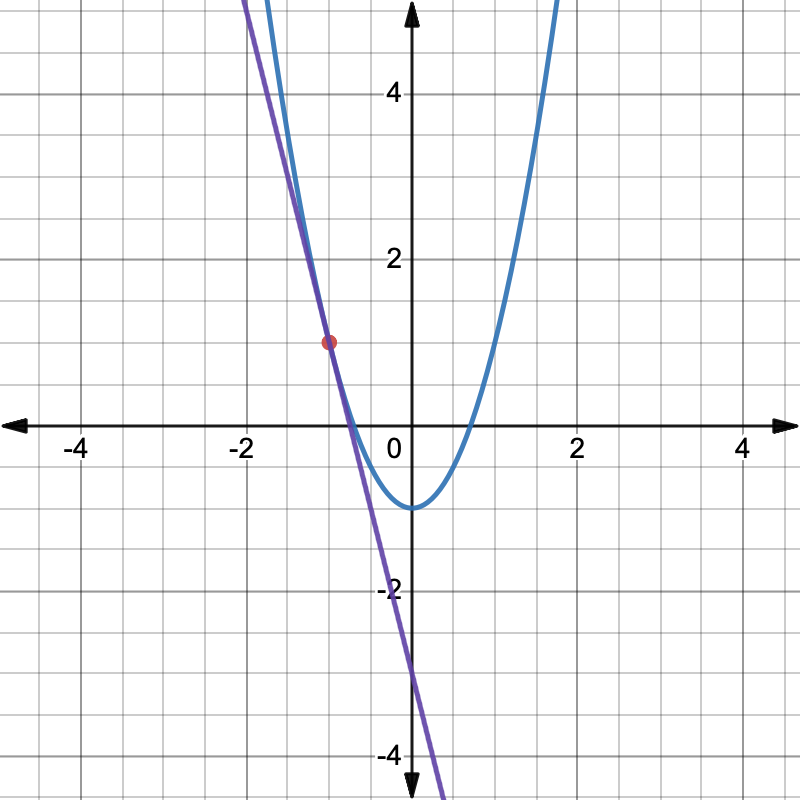
Find an equation for the line tangent to the graph of $f(x) = 2x^2 -1$ at $x = -1$
Solution
Once again, let’s begin by simplifying the main pieces of our limit formula.
- $f(-1 + h)$:
$$ \begin{aligned} f(-1+h) &= 2(-1+h)^2 - 1\cr &= 2(1 - 2h + h^2) - 1\cr &= 2 - 4h + 2h^2 - 1\cr &= 1 - 4h + 2h^2 \end{aligned} $$
- $f(-1) = 2(-1)^2 - 1 = 1$.
Now, we can plug everything into the limit and simplify.
$$ \begin{aligned} \lim_{h \to 0}\frac{f(a+h) - f(a)}{h} &= \lim_{h \to 0}\frac{(1 - 4h + 2h^2) - 1}{h}\cr &= \lim_{h \to 0}\frac{-4h + 2h^2}{h}\cr &= \lim_{h \to 0}(-4 + 2h)\cr &= -4 + 2(0)\cr &= \boxed{-4} \end{aligned} $$
We’ve already computed $f(-1)$ (and got $1$), so we know the point of tangency is $(-1,1)$.
Tangent Line:
$$ \begin{aligned} y - y_1 &= m(x - x_1)\cr y - 1 &= -4(x - (-1))\cr y - 1 &= -4x - 4\cr y &= -4x - 3 \end{aligned} $$
Here’s the sketch.
Projectile Motion
If we ignore wind resistance, the height of a projectile $t$ seconds after it is launched/thrown is given by the equation
$$H(t) = -\frac12 g t^2 + v_0 t + H_0.$$
- $g$: gravitational constant
- $v_0$: initial velocity
- $H_0$: the initial height of the projectile
Exercise
Suppose you throw a ball up in the air with an initial velocity of $15$ m/s (meters per second) from a height of $0$ meters.
- How many seconds does it take for the ball to fall back to the ground?
- What is the ball’s average velocity from $t = 0$ s to $t = 1$ s?
- What is the ball’s instantaneous velocity at time $t = 1$ s?
For simplicity, take the gravitational constant to be $10$ m/s$^2$.
Solution
First, we need to set up our equation for the height of the ball at time $t$:
$$H(t) = -\frac12 (10) t^2 + (15) t + 0$$
$$\boxed{H(t) = -5t^2 + 15 t}$$
(1) The ball hits the ground when $H = 0$.
$$ \begin{aligned} H(t) &= 0\cr -5t^2 + 15t &= 0\cr -5t(t - 3) &= 0\cr t&= \boxed{0, 3} \end{aligned} $$
The ball hits the ground after $3$ seconds.
(2) For the average velocity from $t = 0$ to $t = 1$, we want to compute $\frac{H(1) - H(0)}{1 - 0}$:
$$ \begin{aligned} \frac{H(1) - H(0)}{1 - 0} &= \frac{(-5(1)^2 + 15(1)) - 0}{1}\cr &= 10 \end{aligned} $$
The average velocity is $10$ m/s.
(3) Finally, we want the instantaneous velocity at $t = 1$: $\lim_{h \to 0}\frac{H(1 + H) - H(1)}{h}$:
- Simplify $H(1 + h)$:
$$ \begin{aligned} H(1 + h) &= -5(1 + h)^2 + 15(1 + h)\cr &= -5(1 + 2h + h^2) + 15 + 15h\cr &= -5 - 10h - 5h^2 + 15 + 15h\cr &= -5h^2 + 5h + 10 \end{aligned} $$
-
We already computed $H(1)$: $H(1) = 10$
-
Put it all together:
$$ \begin{aligned} \lim_{h \to 0}\frac{H(1 + h) - H(1)}{h} &= \lim_{h \to 0}\frac{-h^2 + 5h + 10 - 10}{h}\cr &= \lim_{h \to 0}\frac{-h^2 + 5h}{h}\cr &= \lim_{h \to 0}(-h + 5)\cr &= -(0) + 5\cr &= \boxed{5} \end{aligned} $$
The (instantaneous) velocity of the ball after one second is $5$ m/s.