Tangents, Arc Length, Area in Polar
Tangent Lines in polar
Suppose we have a polar curve given by a function of $\theta$. How do we find the slope of the tangent line at a particular point (without converting the whole thing into rectangular coordinates)?
Recall that in the section of parametric equations we concluded that, when $x$ and $y$ are defined in terms of a parameter $t$,
$$ \frac{dy}{dx} = \frac{\frac{dy}{dt}}{\frac{dx}{dt}} $$
Well, in polar coordinates we have
$$ \begin{cases} x = r \cos\theta\cr y = r \sin\theta \end{cases} $$
where $r$ is a function of $\theta$. Let's treat $\theta$ as the parameter. Then
$$ \frac{dy}{dx} = \frac{\frac{dy}{d\theta}}{\frac{dx}{d\theta}} $$
Keep in mind that $r$ is a function of $\theta$. This means we need to use the product rule when differentiating.
$$ x = r\cos\theta \Longrightarrow \frac{dx}{d\theta} = \frac{dr}{d\theta}\cos\theta - r\sin\theta $$
$$ y = r\sin\theta \Longrightarrow \frac{dy}{d\theta} = \frac{dr}{d\theta}\sin\theta + r\cos\theta $$
Putting this all together we have
$$ \frac{dy}{dx} = \frac{\frac{dr}{d\theta}\sin\theta + r\cos\theta}{\frac{dr}{d\theta}\cos\theta - r\sin\theta} $$
Example 1
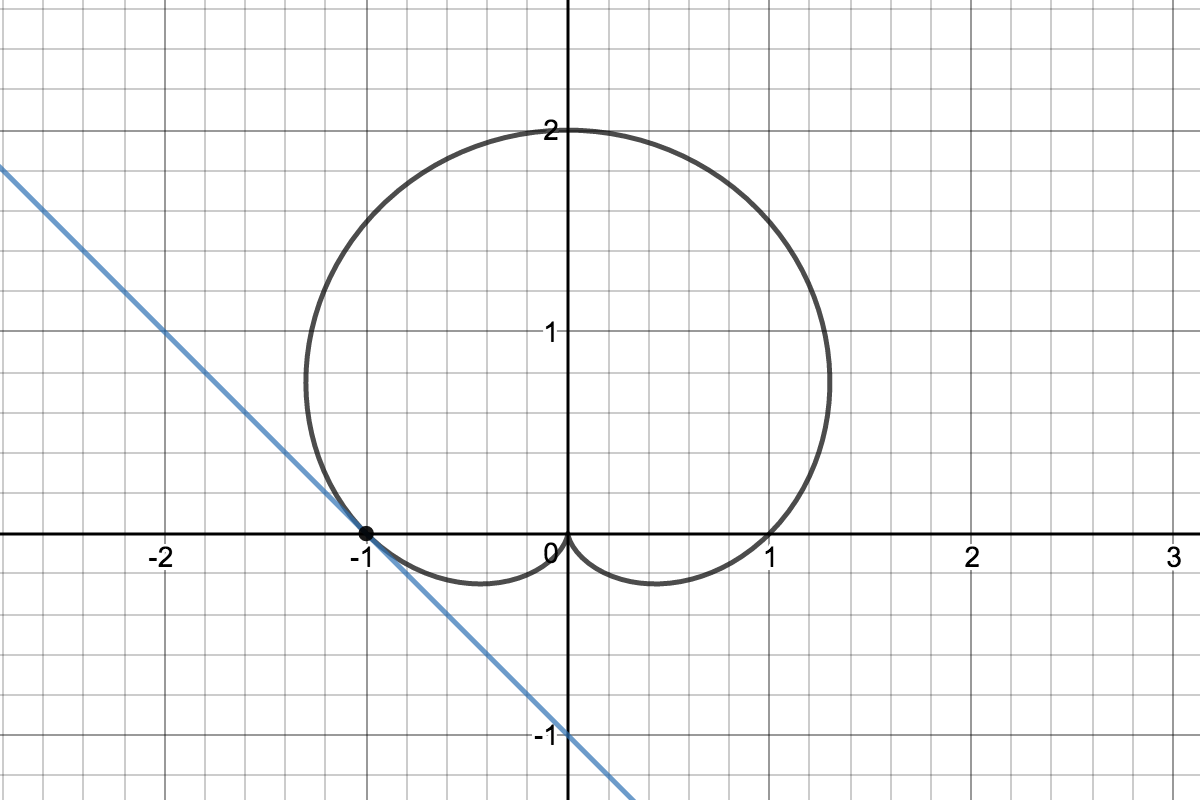
Find the slope of the line tangent to $r = 1 + \sin\theta$ at $\theta = \pi$.
Solution
First, let's find $\frac{dr}{d\theta}$
$$ \frac{dr}{d\theta} = \cos\theta $$
Plugging everything in we get
$$ \frac{dy}{dx} = \frac{(\cos\theta)\sin\theta + (1+\sin\theta)\cos\theta}{(\cos\theta)\cos\theta - (1+\sin\theta)\sin\theta} $$
Evaluating at $\theta = \pi$, we have
$$ \frac{dy}{dx}\biggr\rvert_{\theta = \pi} = \frac{(-1)(0) + (1 + 0)(-1)}{(-1)(-1) - (1 + 0)(0)} = -1 $$
The slope of the tangent line is $-1$.
Looking at the graph, this makes sense:
Cardioid Tangent
Arc Length
For parametric equations, we found the arc length of a given curve is computed as follows:
$$ L = \int_a^b \sqrt{\left(\frac{dx}{dt}\right)^2 + \left(\frac{dy}{dt}\right)^2}\ dt $$
For polar, lets just replace the $t$ with $\theta$.
$$ L = \int_a^b \sqrt{\left(\frac{dx}{d\theta}\right)^2 + \left(\frac{dy}{d\theta}\right)^2}\ d\theta $$
The radical term actually simplifies quite a bit...
$$ \sqrt{\left(\frac{dx}{d\theta}\right)^2 + \left(\frac{dy}{d\theta}\right)^2} =\cdots $$
$$ \cdots = \sqrt{\left(\frac{dr}{d\theta}\cos\theta - r\sin\theta\right)^2 + \left(\frac{dr}{d\theta}\sin\theta + r\cos\theta\right)^2} $$
I'll leave the details to you, but, after cancelling the middle terms and using the pythagorean trig identity, we're left with
$$ \cdots = \sqrt{r^2 + \left(\frac{dr}{d\theta}\right)^2} $$
Example 2
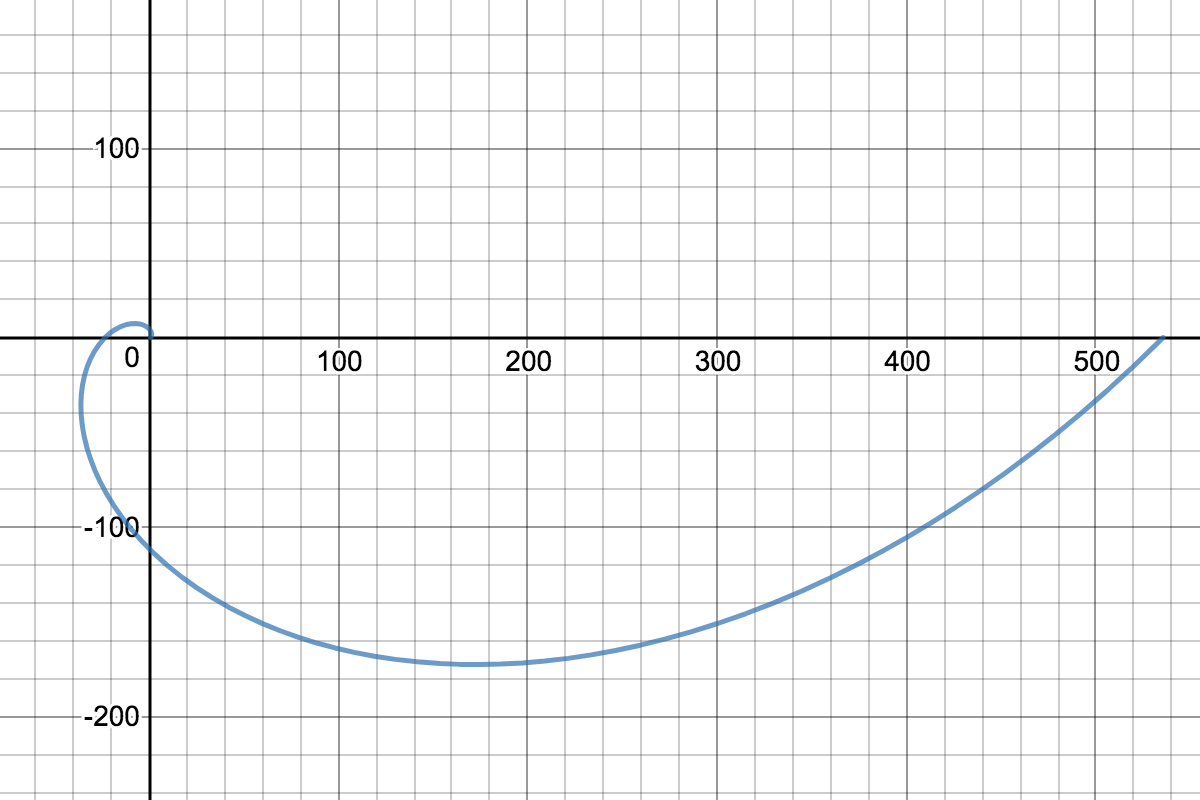
Find the arc length of $r = e^{\theta}$ for $0\leq\theta\leq 2\pi$.
Solution
$$ r^2 = (e^\theta)^2 = e^{2\theta} $$
$$ \frac{dr}{d\theta} = e^{\theta} \Longrightarrow \left(\frac{dr}{d\theta}\right)^2 = e^{2\theta} $$
So the arc length is given by
$$ L = \int_0^{2\pi} \sqrt{e^{2\theta} + e^{2\theta}};dx$$
$$ \cdots = \int_0^{2\pi} \sqrt{2e^{2\theta}}\ d\theta $$
$$ \cdots = \int_0^{2\pi} \sqrt{2}e^{\theta}\ d\theta $$
$$ \cdots = \sqrt{2}e^{\theta} \biggr\rvert_0^{2\pi} $$
$$ \cdots = \sqrt{2}(e^{2\pi} - 1) $$
Area
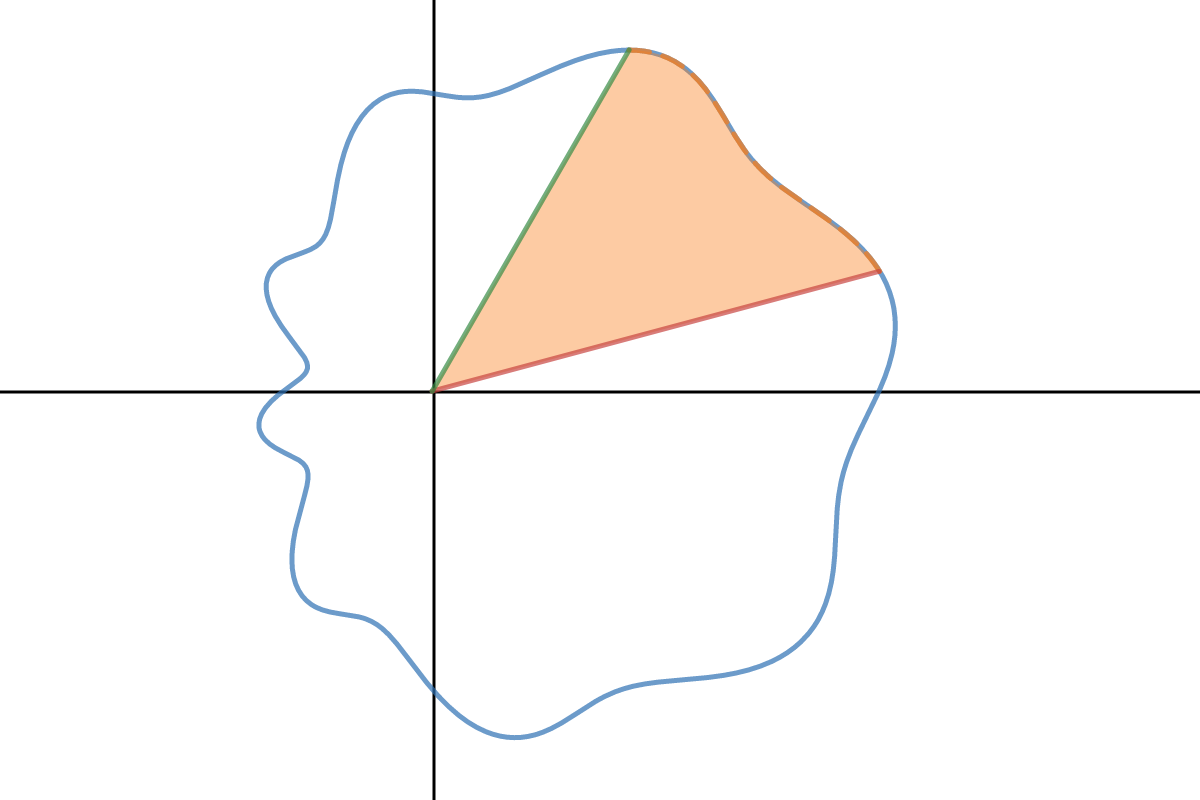
Suppose we want to find the area bounded between a polar curve $r = r(\theta)$ and the angles (or lines) $\theta = \alpha$ and $\theta = \beta$. It might look like this:
figure
Polar Area
When we wanted to find area in rectangular coordinates, we split the region up into tiny rectangles. In particular, we took an interval like $a \leq x \leq b$ and split it up into even sub-intervals.
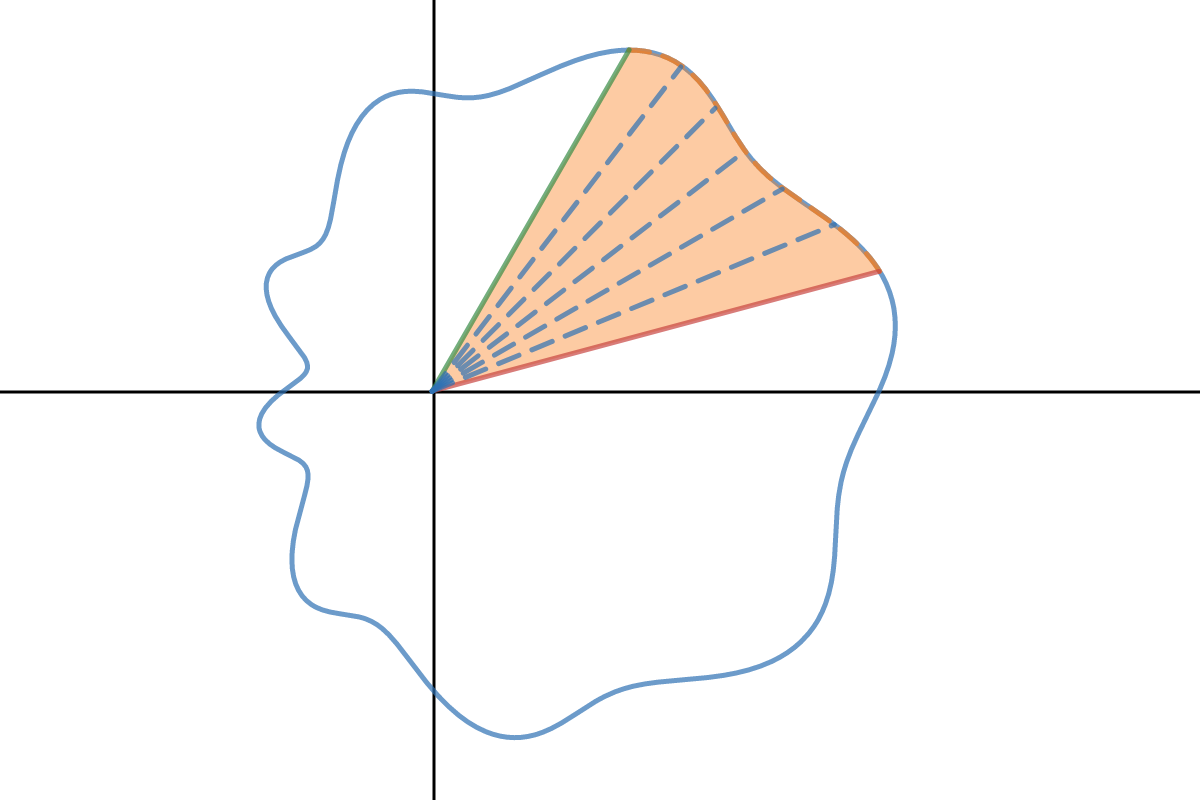
Now, our independent variable is $\theta$, so we need to break the interval $\alpha \leq \theta \leq \beta$ into sub-intervals. But, when we do this we'll get sectors rather than rectangles.
figure
Polar Area
The area of a sector is $\frac12 r^2 \theta$, so if we have a tiny change in $\theta$, we can write this as $\frac12 r^2 d\theta$. To add up all of the tiny sectors, we get
$$ A = \int_{\alpha}^{\beta} \frac{1}{2} r^2 \ d\theta $$
Example 3
Find the area bounded inside the cardioid $r = 1 + \cos \theta$ over $\pi/4 \leq \theta \leq \pi$.
Solution
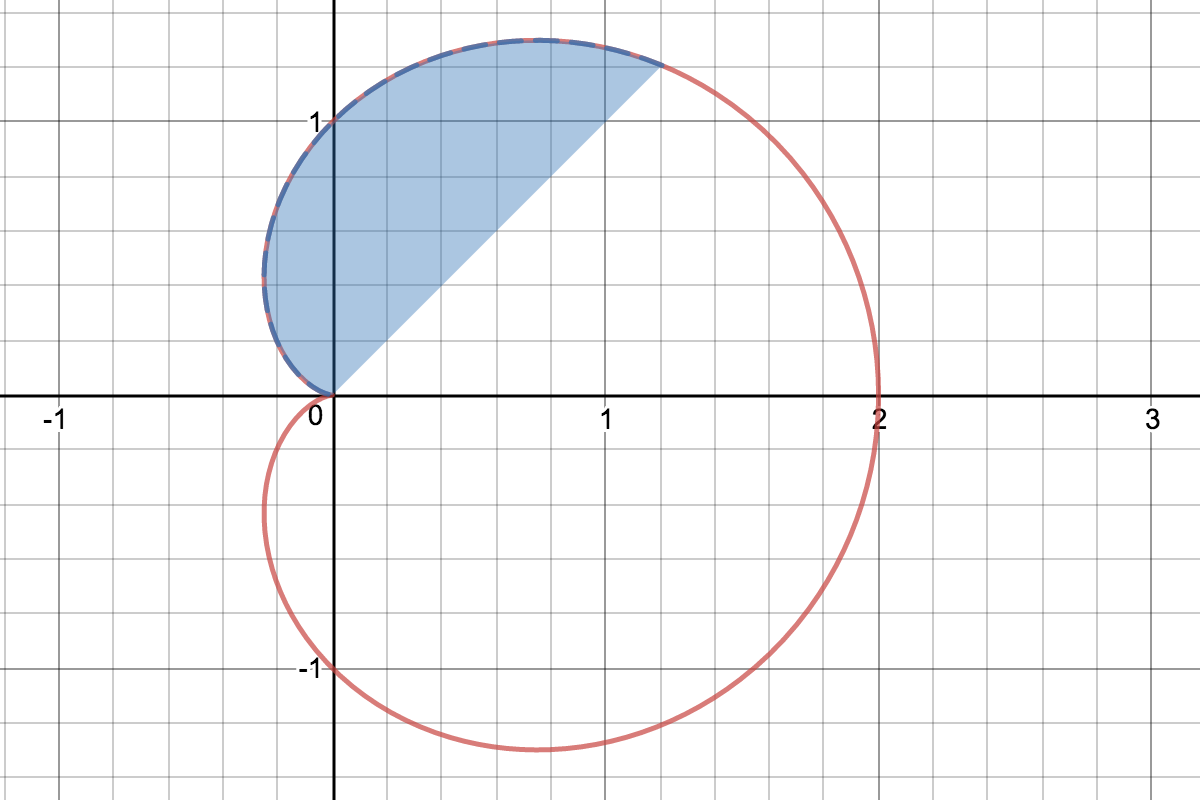
Cardioid Area
$$ \begin{aligned} A &= \int_{\pi/4}^{\pi} \frac{1}{2} (1+\cos\theta)^2 \ d\theta \cr &= \frac{1}{2} \int_{\pi/4}^{\pi} (1+2\cos\theta + \cos^2\theta) \ d\theta \end{aligned} $$
To integrate $\cos^2\theta$, we need to use the double angle formula.
$$ \begin{aligned}
\end{aligned} $$
$$ \cdots = \frac{1}{2} \int_{\pi/4}^{\pi} (1+2\cos\theta + \frac12 + \frac12\cos2\theta) \ d\theta $$
$$ \cdots = \frac{1}{2} \int_{\pi/4}^{\pi} (\frac32 +2\cos\theta + \frac12\cos2\theta) \ d\theta $$
$$ \cdots = \frac{1}{2} \left(\frac32\theta +2\sin\theta + \frac14\sin2\theta\right) \biggr\rvert_{\pi/4}^{\pi} $$
$$ \cdots = \frac{1}{2} \left[\left(\frac{3\pi}{2} +0 + 0\right) - \left(\frac{3\pi}{8} + \sqrt{2} + \frac14\right) \right] $$
$$ \cdots = \frac{9\pi}{16} - \frac{\sqrt{2}}{2} - \frac{1}{8} $$
Example 4 (HW #13)
Say we want the area common to $r=3\sin\theta$ and $r=3\cos\theta$.
Solution
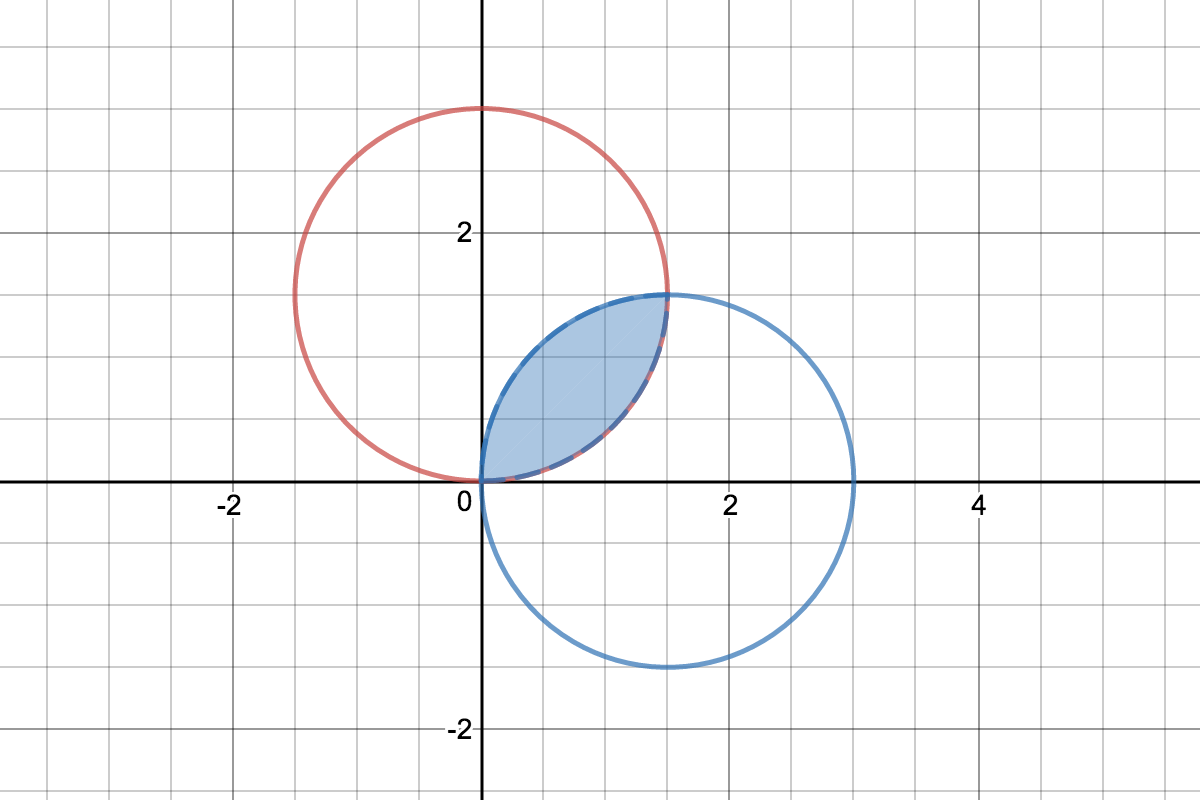
Common Area
Let's first find the intersections of these circles:
$$ 3\sin\theta = 3\cos\theta $$
$$ \sin\theta = \cos\theta \Longrightarrow \theta = \pi/4 $$
Even though it might not look like it, we need to do this as two separate areas:
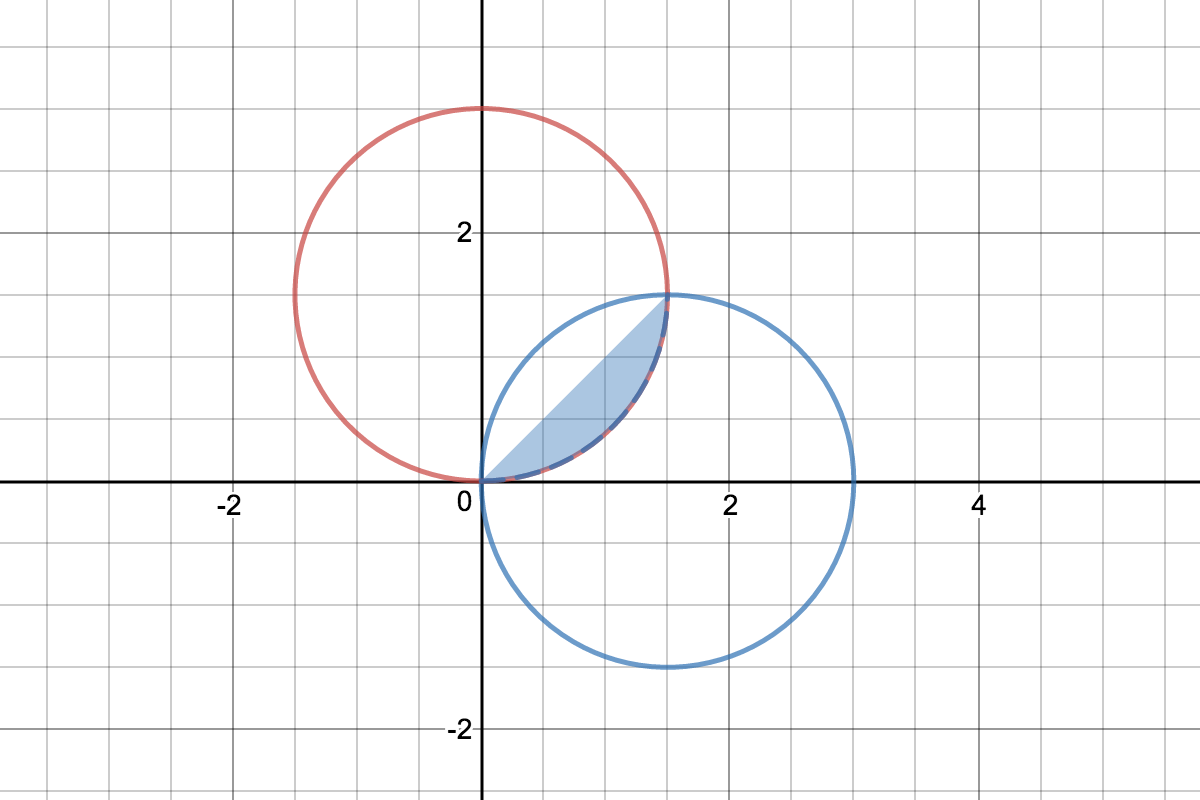
For the first part, we have
$$ A = \frac{1}{2}\int_0^{\pi/4} (3\sin\theta)^2\ d\theta $$
$$ \cdots = \frac{1}{2}\int_0^{\pi/4} 9\sin^2\theta\ d\theta $$
$$ \cdots = \frac{9}{2}\int_0^{\pi/4} \frac12 - \frac12\cos2\theta\ d\theta $$
$$ \cdots = \frac{9}{4} \left(\theta - \frac12\sin2\theta \right)\biggr\rvert_0^{\pi/4} $$
$$ \cdots = \frac{9\pi}{16} - \frac{9}{8} $$
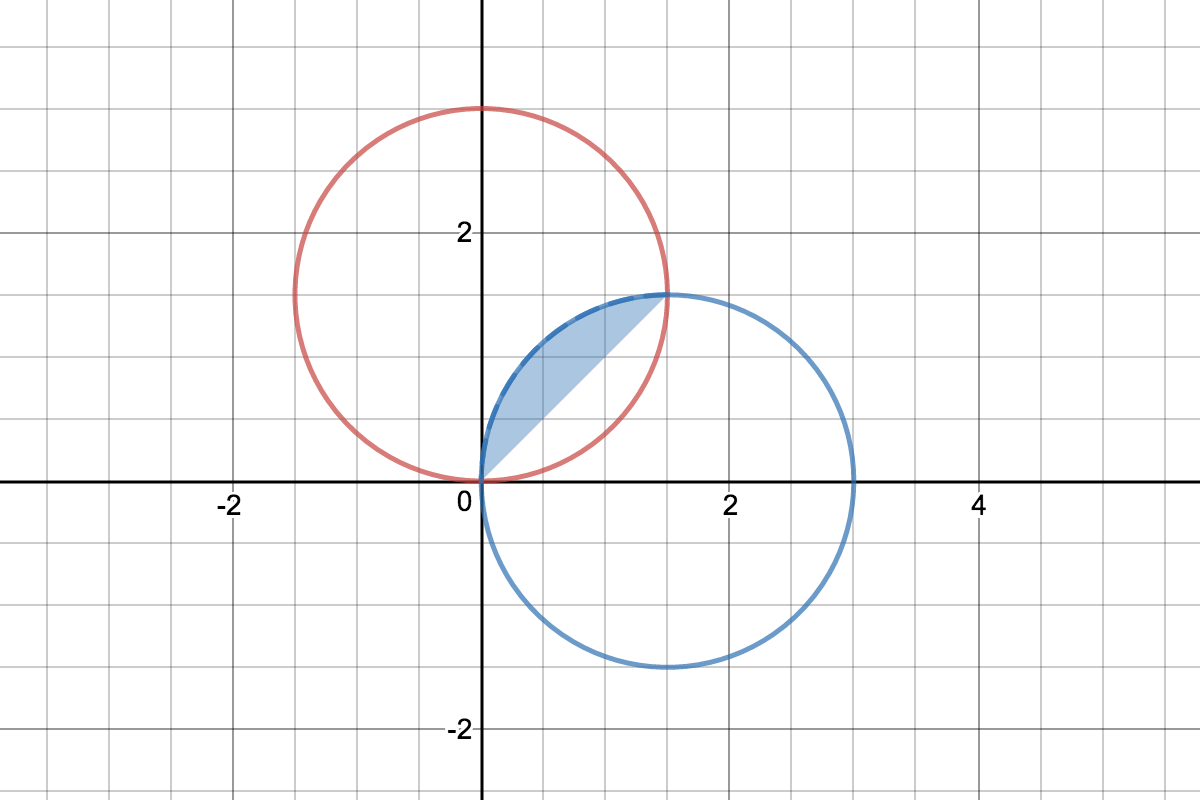
Area Pt. 2
For the second part we have
$$ A = \frac{1}{2}\int_{\pi/4}^{\pi/2} (3\cos\theta)^2\ d\theta $$
$$ \cdots = \frac{1}{2}\int_{\pi/4}^{\pi/2} 9\cos^2\theta\ d\theta $$
$$ \cdots = \frac{9}{2}\int_{\pi/4}^{\pi/2} \frac12 + \frac12\cos2\theta\ d\theta $$
$$ \cdots = \frac{9}{4} \left(\theta + \frac12\sin2\theta \right)\biggr\rvert_{\pi/4}^{\pi/2} $$
$$ \cdots = \frac{9\pi}{16} - \frac{9}{8} $$
Now we just add up our answers: $A = \frac{9\pi}{8} - \frac{9}{4}$
Example 5 (HW #12)
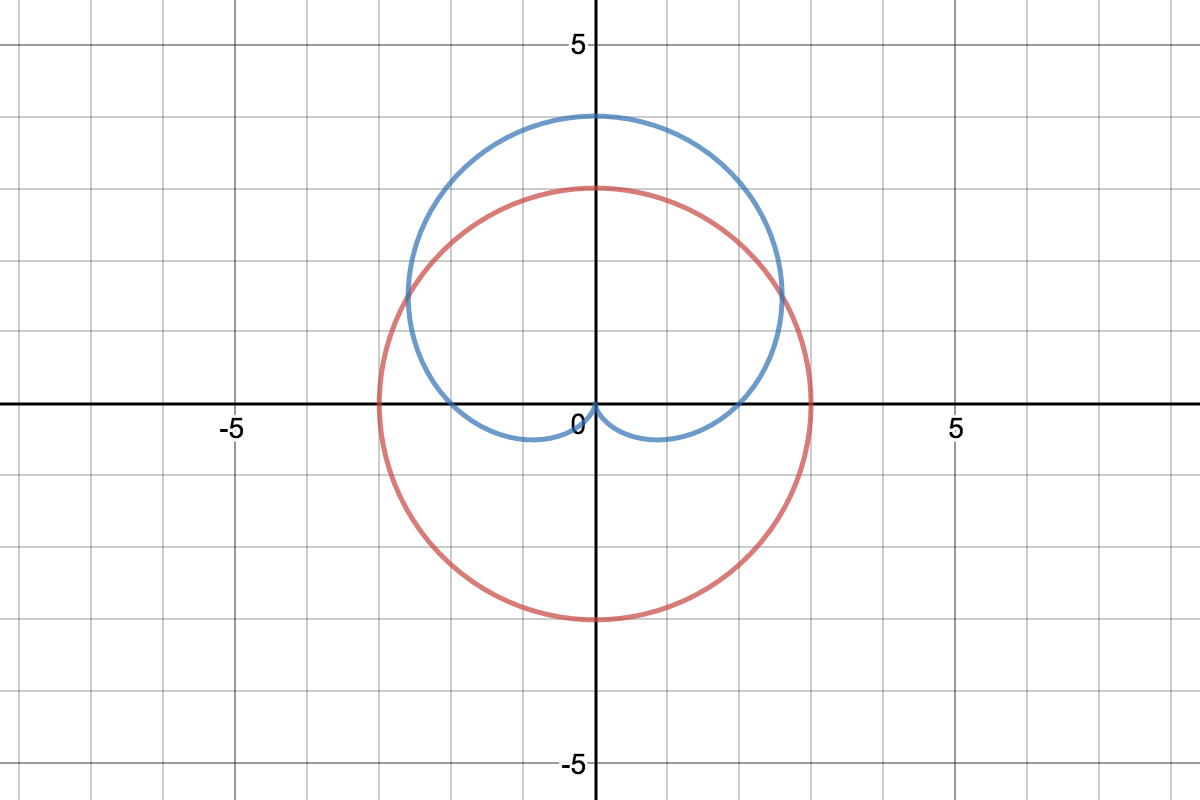
Find the area of the region outside the circle $r=3$ but inside the cardioid $r = 2 + 2\sin\theta$.
Solution
Cardioid and Circle
First, we need to find the intersections of these two curves.
$$ 2 + 2\sin\theta = 3 $$
$$ 2\sin\theta = 1 $$
$$ \sin\theta = 1/2 \Longrightarrow \theta = \frac{\pi}{6}, \frac{5\pi}{6} $$
We now know that we have to integrate over $\left(\frac{\pi}{6}, \frac{5\pi}{6}\right)$. On that interval, the cardioid is further from the origin than the circle, so we are going to be subtracting the area of the circle from the cardioid.
$$ A = \frac{1}{2} \int_{\pi/6}^{5\pi/6} \left((2+2\sin\theta)^2 - (3)^2\right)\ d\theta $$
$$ \cdots = \frac{1}{2} \int_{\pi/6}^{5\pi/6} \left(4+8\sin\theta + 4\sin^2\theta - 9\right)\ d\theta $$
We need to apply the double angle formula for the $\sin^2\theta$ term.
$$ \cdots = \frac{1}{2} \int_{\pi/6}^{5\pi/6} \left(8\sin\theta + 2 - 2\cos2\theta - 5\right)\ d\theta $$
$$ \cdots = \frac{1}{2} \int_{\pi/6}^{5\pi/6} \left(8\sin\theta - 2\cos2\theta - 3\right)\ d\theta $$
$$ \cdots = \frac{1}{2}\left(-8\cos\theta - \sin2\theta - 3\theta\right)\biggr\rvert_{\pi/6}^{5\pi/6} $$
$$ \cdots = \frac{1}{2}\left[\left(4\sqrt3 +\frac{\sqrt3}{2} - \frac{5\pi}{2}\right) - \left(- 4\sqrt3 - \frac{\sqrt3}{2} - \frac{\pi}{2}\right)\right] $$
$$ \cdots = \frac{9\sqrt3}{2} - \pi $$